PILGRIMAGE BLOG
What are the Benefits of Yin Yoga?
The Benefits of Yin Yoga
By Lena Schmidt
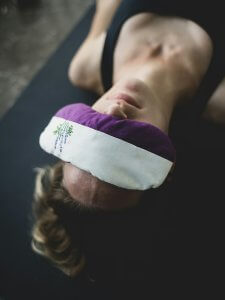
We often spend our days on edge and in a heightened state of anxiety and stress. Bombarded by car horns, ambulance sirens, constant social media interactions, and sales pitches, peace and quiet are nowhere to be found. We aren’t being chased by tigers like some of our distant ancestors, but endless alerts on our cell phones and the constant pinging of emails can trigger the animal fight-or-flight response in the brain and nervous system. The result? Anxiety, high blood pressure, and insecurity, and difficulty calming down to enjoy a little peace and quiet. Enter yin yoga.
“Ahhhh …” *sigh* “ Inhaaaaale …” “Exaaaaale …” These are the sounds you might hear as you settle into a yin yoga class. Exit anxiety and stress. Enter inner peace and quiet. Nice—right? You might be wearing yoga clothes, pajamas, and comfy socks. You might have a blanket or two on your yoga mat for extra warmth and cushioning. You can expect to experience soft, relaxing music, simple sounds of nature, or a comfortable quiet. These are but some of the immediate benefits of yin yoga. More are awaiting you, so give yin yoga a try—you’ll be glad you did.
While not a panacea for all of society’s ills, or a replacement for professional therapies when needed, yin yoga can be surprisingly healing. In a yin yoga class, your nervous system can relax. Your breath can slow down and become calm. Your eyes can rest. In a yin yoga class, you experience guided breathwork, gentle warm-ups, an introduction to mindfulness meditation, and simple poses that you hold for several minutes. While some yin yoga poses may be unfamiliar to you, it won’t be long before you are sitting and lying easily, allowing gravity to the work of healing for you.
Chinese medicine tells us that Yin is in contrast to Yang. Yin means passive or effortless, whereas Yang is active. This contrast is not a competition; both of these dynamic forces are complementary and necessary for a well-rounded life. In our busy lifestyle, however, the natural healing action of deep relaxation can be absent. We have to relearn how to relax. This is where yin yoga can be extremely helpful.
Unlike gentle or mellow yoga, yin yoga poses might be held for several minutes—from one to as much as twenty minutes. Most will be held from three to eight minutes. Yin yoga is designed to affect the deeper muscles, connective tissues, and fascia. Unlike restorative yoga, yin yoga is often practiced without the use of props. Although it is relaxing, the poses may not always feel restful. Most of us are not used to being still for long periods of time. We need the assistance of external aids like furniture, stimuli like music, or sleep aids. There is a great benefit to just learning how to be still without these props. .
Sarah Powers, author of Insight Yoga: An innovative synthesis of yoga, meditation and Eastern approaches to healing and well-being, writes that yin yoga has the ability to:
- Calm the nervous system
- Offer relief from anxiety
- Offer relief from chronic pain
- Teach us how to avoid repeating destructive patterns
- Help us learn how to surrender
These effects can be felt immediately or by the end of the class. Consider how long it takes you to really settle into savasana at the end of a vinyasa class. Or how long it takes to fall asleep even after you go to bed. When doing yin yoga, give yourself time to settle and soften into the poses. Once there, try not to move around too much. Resist the urge to scratch that itch or flick that piece of dust off your new outfit. When you resist the urge to shift at the first sign of discomfort in yoga, you develop patience and increase your tolerance of discomfort. There is a spiritual and psychological, as well as a physical benefit. You become resilient. You become skillful at discerning between the legitimate warnings of pain and the merely uncomfortable. If you do experience a vivid or enduring pain during a posture, go ahead and shift your position, rearrange your limbs or props, and ask the teacher for assistance.
Yin yoga is becoming more popular because it works and is accessible for most body types. With practice, you will find the right posture and position for your physical needs. Ask your teacher to help you settle into new or difficult poses. If you have an acute injury, you should avoid poses that put pressure on an area that needs to heal. Yin yoga may not be the best form of yoga for pregnant students, as it can be taxing on increasingly flexible ligaments. (Editor’s note: I want to be sure the author didn’t mean to say, “inflexible ligaments” here.) If you are pregnant and taking a yin yoga class, consider using more props for support so as not to overstretch.
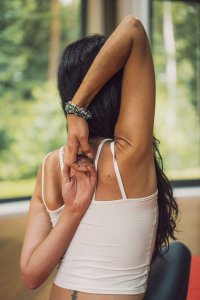
Try these yin yoga poses when you need to relax or before going to bed:
Editor’s Note: Images are desirable for the following three poses.
Sphinx Pose: Come down onto your belly. Prop yourself up onto your elbows. Align your elbows right underneath your shoulders. Wiggle your hips from side to side to nestle in. Draw your shoulder slightly back in space and lift your chest. Gaze forward or close your eyes. After several breaths, slowly let your chin tip towards your chest. Gently rock your head from shoulder to shoulder. Relax your face and jaw. Settle into stillness and hold for three to five minutes.
Child’s Pose: Come to hands and knees. Bring your big toes together and widen your knees. Send your hips back towards your heels. Reach your arms out in front of you or create a ‘pillow’ by placing one hand on top of the other. Rest your head on the floor or your hands and hold for three to five minutes.
Legs up the Wall: Place a pillow or blanket next to a wall. Lay on your back and swing your legs up against the wall. Slide your hips as close to the wall as is comfortable for you. Rest your hands on your belly or up and over your head. Allow your feet to separate naturally. Hold for five to ten minutes.
Try it, you’ll like it! Yin yoga can bring surprising and much-needed benefits to our busy and often stressful lives.