PILGRIMAGE BLOG
From Dharma to Dollars: The Cost of Selling Yoga
Yoga – an ambiguous four-letter word filled with countless interpretations – includes a variety of disciplines and schools of thought. Today, modern postural-based yoga has become increasingly popular in Western culture, with nearly 40 million practitioners in the United States[1]. The Western market has undoubtedly influenced the presentation of yoga, allowing for the expansion of a billion-dollar industry with new classes, studios, and yoga styles emerging daily. However, despite its growing popularity, there remains a lack of awareness regarding its deeper philosophical and spiritual systems. This ethnographic study examines how modern studios navigate the balance between upholding yoga’s philosophical and spiritual systems and maintaining a sustainable business in a commercialized environment that heavily appeals to fitness-focused trends by conducting fieldwork observations, analyzing marketing strategies, and conducting interviews.
For most Western practitioners, our journey begins in fitness-focused environments with no emphasis on yoga’s meditative, philosophical, or spiritual aspects. I started practicing modern postural-based yoga when I was 10 years old at the local community gym as a means for me to move my body. As my daily practice continued, I noticed subtle shifts in my overall demeanor and felt a deeper pull to explore things further. When I arrived at a studio that appeared to integrate deeper philosophical and spiritual teachings, my focus was no longer on solely attaining a particular posture but instead shifted to inquiring a deeper understanding of the practice – and thus, began embarking on the journey inward toward growth and self-realization. Yoga became my greatest teacher and allowed me to rediscover a deep capacity of awareness within – allowing my practice to permeate every aspect of my life.
These experiences, both in my upbringing and current perspective, have deepened my appreciation for practitioners, instructors, and studios that devote themselves to embodying the practice—moving far beyond any posture and living their teachings off the mat. Therefore, my stance on yoga inevitably shapes my understanding and perception of how philosophical and spiritual aspects of practices can become diluted, excluded, or reduced only to postural-based practices while trying to appeal to fitness-focused trends in the consumer-driven culture of the West.
Could it be that in attempts to attract more clients, studios reveal their motive in trying to profit from selling yoga? What is the cost of selling yoga in the context of compartmentalizing and commodifying a seemingly deconstructable, undefining practice? What is intentionally included and excluded in modern postural-based practices, and who does this benefit? As a yoga practitioner, these are genuine questions that I’ve spent time reflecting on and have undoubtedly guided my inspiration for conducting this study – both academically and personally. My research seeks to explore the presentation of yoga in commercial settings to further examine the implications Western consumerism has on influencing the way modern yoga is perceived, purchased, and practiced.
Methods
This ethnographic study examines Pilgrimage of the Heart, a yoga studio located in San Diego, California – a city known for its diverse and thriving yoga culture. I conducted my research over the course of 4-weeks by analyzing online material, participating in a class at the studio, and interviewing the studio’s founder, Sujantra McKeever. I registered for the Tuesday night class titled ‘Free Meditation’ using the Mindbody app, which was easily accessible and user-friendly. The class I attended lasted roughly 75 minutes and had over 50 practitioners, ranging in age, gender, and race – highlighting the studio’s vast and diverse reach.
While conducting my pre-fieldwork research, I used a method developed by Sarah Pink, Netnography, which analyzes a particular group’s digital interactions and online communities. I collected data from their website and social media platforms beforehand to better understand their brand image and marketing strategies and then highlight any differences in personal experience during my fieldwork observations. While participating and observing, I paid close attention to the presentation of yoga in a commercial setting by assessing the size of the studio’s retail space, overall aesthetic, and the instructor’s awareness or ability to integrate yoga philosophies and broader spiritual contexts into the class. After attending class, I asked the instructor if he would be interested in participating in an interview for my study.
My role in this study was as an observer and an active participant, allowing for the integration of my subjective experiences in this confessional-style ethnography. My approach to the research drew from my background as a yoga practitioner with a passion for understanding and embodying the philosophical and spiritual contexts of the practice. Additionally, my research will synthesize and connect my findings to concepts of ‘dharma, karma, and selfless service’ as depicted in the Bhagavad Gita (Patton) to further explore what is excluded in the process of commercializing yoga by reducing it merely to the physical, postural-based aspects of the practice. Other sources, both from course readings and outside websites, will help provide more context in navigating the complexities of this tension by highlighting questions and discussions relevant to strengthening the new ways of knowledge present in this study.
Findings
Website & Social Media Analysis
After analyzing their website and social media, the branding and marketing strategies for Pilgrimage of the Heart appear to align with the studio’s mission to bring ‘Balance, Strength, and Flexibility’ in an accessible way to the lives of practitioners. Additional material is abundant on their website, ranging from the studio’s founding history to diverse and relevant blog posts suitable for practitioners of any age or level. Pilgrimage of the Heart also has its own YouTube channel with video topics consisting of conscious relaxation and meditation, philosophy, kirtan performances, and free live-stream Zoom sessions. There is a wide variety of class offerings published on their website
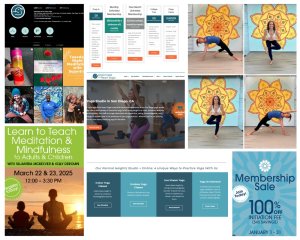
with options for indoor, outdoor, live steam, and on-demand yoga as well as over 10 class styles ranging from ‘dynamic, athletic side of yoga’ (Flowing Yoga I-II) to ‘open[ing] your throat chakra and heart through vocal expression’ (Mantra & Meditation). Pricing options vary from free, $25 per class, $25 special for a 2-week trial, $100 monthly memberships, and class cards that go upwards of $235 for 10 classes, which can accommodate a variety of practitioners’ budgets and commitment levels, suggesting an inclusive approach. The presentation and tone of their website seem to reflect the studio’s overall philosophy as it is oriented towards mindfulness – focusing on peace, meditation, and wellness while also offering classes appealing more towards the physical aspects of the practice.
I chose to analyze their social media platforms to further explore the studio’s marketing strategies and its level of community engagement. Their Instagram account, ‘@pilgrimageyoga’, revealed various content, including class schedules, promotions, inspirational quotes, and live recordings of classes led by Sujantra. From an outside perspective, it appears that their posts emphasize philosophical and spiritual aspects of the practice by providing teachings from meaningful texts and offering free meditation sessions. For example, one post states, “Elevate your week with our FREE weekly meditation offerings! Join us as we dive into moments of serenity and self-discovery every week.” with frequent hashtags including: “meditation”, “mindfulness”, “om”, “gong”, and “spirituality”.
Its Instagram fosters a unique sense of belonging for its practitioners through community-engaging posts such as the weekly student features that can help create personal connections among practitioners. Furthermore, certain posts depict real-life participation in the studio, which illustrates their commitment to the community and potential desire to attract new clients. Upon further examination, promotions for special class pricing and memberships occasionally include deals on their merchandise. Still, the primary focus of their marketing strategies goes beyond retail sales.
In-Person Fieldwork Observations & Analysis

As I entered the studio, I instantly noticed the ample, community-focused space that fostered a deep sense of peace and ease. Pilgrimage has 2 locations on the corner of the same street with multiple rooms for different classes, which suggests their efforts to simultaneously hold space for various groups of practitioners. The studio feels like a sanctuary rather than a fitness center as it incorporates decorative plants, candles, and spiritual symbols to create a calm and meditative atmosphere. I noticed the studio had a visible retail section roughly half the size of the lobby – offering a mix of yoga props and wellness products, including their own branded merchandise, jewelry, crystals, and books.
As I checked in for the class, the front desk staff greeted me with a warm welcome, and they were excited to hear that I was attending class to do fieldwork for my research project. Sujantra began class by briefly introducing the sound healing practitioners, Sanjana and Sanaa, and reminding the group of upcoming studio events, including song circles, workshops, and meditation training. Sujantra then dove into the topic for meditation: Jnana yoga, the yoga of wisdom and knowledge. Sujantra prefaced by stating that the class had devoted the past two weeks to focusing on Bhakti yoga and Karma yoga – revealing the paths to yoga as outlined in the Bhagavad Gita. Sujantra described Jnana yoga as “the capacity we all have to distinguish what serves us and what does not—what brings forward our best self and what does not,”. He proceeded to introduce a mudra, invoking clarity and intuition.
Sujantra spent 5-7 minutes leading the class through a series of seated postures and breathing techniques to prepare our bodies for stillness. Sujantra instructed us to close our eyes and use body awareness to draw our hands together in the mudra he introduced at the beginning of class – which I found extremely helpful and interesting. The meditation lasted 25 minutes and aimed toward deep reflection by exploring how happiness is not external but an innate part of our being. Sujantra stated, “Happiness doesn’t come from things – it is the moment you allow yourself to be happy – not because of the possession but because you’ve decided to be happy.” After the meditation, Sujantra invited first-time attendees to receive a book by Sri Chinmoy, honoring his teacher’s legacy, “He always taught meditation for free, and that’s the reason I’m here at the studio, to offer meditation for free.” Following the class, Sujantra invited attendees to stay and connect over tea to share their experiences during the meditation. I found it refreshing to interact with community members and integrate the teachings from the meditation together. Before I left, I spoke with Sujantra to ask if he would be interested in an interview for my research project, and he happily agreed.
Interview Analysis
My interview with Sujantra took place on Friday, February 28th, over Zoom and lasted approximately 25 minutes. I prepared a series of questions addressing Sujantra’s approach to presenting yoga in a commercial setting, aiming to deepen my understanding of the complexities involved in navigating the balance of yoga in a commercial setting. With decades of experience in meditation and spiritual teaching, Sujantra undoubtedly provides a unique perspective on how he finds balance in teaching with spiritual integrity while maintaining a sustainable business in a commercialized environment.
Sujantra fondly recalled his studentship under Sri Chinmoy, which allowed him to meet diverse groups and experience worldwide culture with different religions and spiritual paths—specifically referring to a time in the 2000s when he felt a calling to share meditation teachings with others. At the time, he saw an uptick in Western practitioners’ interest in asana practice, stating, “I thought, let me open a yoga studio – this will give me access and visibility to a lot more people, and then I’ll be able to explain and teach the full spectrum of yoga. Which is everything from conduct to asana, all the way through deep meditation”.
I found his perspective extremely intriguing and questioned if he guides or encourages practitioners who initially come for the physical benefits to embrace the deeper aspects of the practice. Sujantra replied with little to no hesitation, stating that he trusts in the process of yoga to unfold at the individual level of the practitioner for them to fully examine the deeper aspects of the practice themselves, stating, “I really trust in the process of yoga and the process of personal growth and understanding – which is the essence of yoga.” While Sujantra clearly expresses the importance of honoring and respecting the initial desires of why a practitioner comes to class, he also deeply trusts that through gaining more body and breath awareness, practitioners will discover a deeper experience.
Pilgrimage of the Heart offers 40 weekly classes, roughly 10% of which are rooted in meditation, mantra, and sound healing. Sujantra describes how the different class offerings reflect the various limbs of yoga from Patanjali’s Eight Limb Path. The studio offers classes specifically focused on learning to still the body and turn awareness inward instead of solely focusing on being in movement. I asked if he believes their marketing reflects this mission rather than appealing exclusively to fitness-focused trends in the wellness industry. Sujantra replied by stating, “We put a wide range of people – often pictures of people smiling and sitting in meditation – we don’t just have pictures of young, super healthy people sweating in yoga asanas” and mentioned how their marketing tries to convey what yoga means to them: “happiness, smiling, and a sense of community.” Sujantra then referred to the studio’s tagline, ‘Balance, Strength, and Flexibility,’ and explained how they could apply to the mind, body, and soul in stating that “Yoga works for dealing with the whole spectrum of human beings.”
Among all the various classes offered, I wanted to know how they determined what offerings are free versus others that require a financial commitment. For example, Sujantra leads a free, weekly mantra and meditation class, whereas the asana-based classes are primarily a minimum $25 drop-in rate. Sujantra recalls his teacher, Sri Chinmoy, during the founding years of the studio, stating, “We decided that I’ll create a studio where we charge for the asana, posture-based classes because that is very standard in our society, and it’ll help make a business but I’ll offer meditation for free.” I followed by inquiring if he noticed how his students perceived this distinction in price as an offering of ‘less value’.
In other words, do the free weekly meditation classes insinuate or give the impression that it is free because it is less valuable than the asana-based class that charges $25? Considering the name of the studio, it was no surprise that Sujantra offered a refreshing response, “I would say personally it becomes of more value because it’s an offering from the heart and also it is a spiritual offering.”. Furthermore, stating that, “For the practitioner, I feel they feel as though it is a very pure and clean environment. They’re being offered something, and it has a spiritual vibration because it’s not commercial interaction – it’s human interaction.” Thus confirming the studio’s rooted intention to make yoga accessible to all.
Interpretation
Through the examination of these findings, it is evident that the commercialization of yoga has undoubtedly resulted in a significant shift in how yoga is practiced, presented, and experienced.[2] Sujantra primarily focuses his classes on philosophical teachings, meditation, and breathwork in a way that’s relatable and easy to digest. More specifically, during my participation, he centered the class around the concept of the yoga of wisdom, Jnana yoga, as depicted as one of the paths to yoga in the Bhagavad Gita. Sujantra’s emphasis on Jnana yoga and inner transformation over physical achievement highlights his intentional effort to educate and guide practitioners beyond postural-based practices.
Sujantra’s decision to offer meditation for free is deeply rooted in the philosophical principles of his teacher Sri Chinmoy but also connects to the broader concept of selfless action, or karma yoga. In the Bhagavad Gita, translated by Patton, Krishna tells Arjuna, “Your authority is in action alone, and never in its fruits; motive should never be in the fruits of action, nor should you cling to inaction,” – emphasizing the importance of motive in selfless devotion over material success.[3] However, Pilgrimage of the Heart is still a business and must generate revenue to serve its practitioners and community by paying utility bills, rent, etc. In Contemporary Expressions of Yoga, Chapple sheds light on the concept of ‘aparigraha’, or non-possession, by stating, “By restricting one’s ownership of things, one is able to release attachment from external objects”, while also later acknowledging the limitations of the market-driven economy that relies on growth in the consumer sector.[4] I found this to be insightful as it implies that the backbone of this tension is rooted in the balance of upholding philosophical and spiritual integrity while also aiming to meet the demands of the consumer to ensure business viability.
The Big Business of Yoga states that whether or not yoga remains an inner transformational practice or evolves into a commercialized fitness industry, integrity and discernment depend on the motivations of practitioners, instructors, and studio owners.[5] Similarly, I believe that Sujantra’s intentional efforts to offer free meditation reveal the true motivation behind his studio – acting as an offering from the heart. As a devoted student, Sujantra honors and upholds the legacy left behind by his teacher, Sri Chinmoy, to serve as a means of reverence rather than rigidity or routine. Sujantra’s desire to selflessly serve others is the purpose behind the profit of his business – whereas, in other studios, one can see how profit drives their purpose.
Sujantra claims that we must trust that the process of yoga unfolds at the individual level of the practitioner so that they can further explore and dive deeper into the practice. Similarly, yoga practitioners must hold studio owners and instructors to a higher standard because they are the guiding hand in facilitating and presenting yoga in a commercialized environment. Adam Keen, from Purple Valley Yoga, suggests that “if you get people practicing, sooner or later they will ask deeper questions,” and while I believe Pilgrimage of the Heart embodies this understanding for the practitioners’ journey, I also think that as a studio they can support the unfolding curiosity of practitioners by facilitating experiences that move beyond the asana and strike inquiry to explore things deeper.[6] Through the examination of these sources in the context of my findings, it is evident that Pilgrimage of the Heart embraces and incorporates philosophical and spiritual integrity while also operating a sustainable business in a commercialized setting.
Discussion
These findings offer valuable insights into the yoga industry while also contributing to broader social science discussions involving commodification and the dynamics of Eastern spiritual practices in Western cultures. More specifically, this study highlights how commercialized environments do not automatically destroy integrity but instead reinforce what matters: the intention and motivations behind studio owners, instructors, and practitioners.
A limitation of this study is its scope, given that only one studio was examined over a 4-week period—further suggesting that these results cannot be generalized to larger populations, such as all modern yoga studios. Additionally, my role as an observer and participant in this study adds a level of subjectivity that poses a limitation because the findings could be perceived or interpreted differently depending on the observer or participant.
Future research could be expanded to incorporate a broader scale of various studios in order to compare and contrast how each studio navigates the balance of yoga in a commercialized environment. Additionally, conducting interviews with practitioners could shed light on understanding how yoga is presented in a commercial setting and how said practitioners perceive that presentation.
Conclusion
In conclusion, this ethnographic study suggests that the commercialization of yoga does not erase philosophical and spiritual systems; what matters is the intentions and motivations of the practitioners, instructors, and studio owners. By conducting fieldwork at Pilgrimage of the Heart, I observed first-hand how studios can still succeed in a commercial setting while providing pathways for practitioners to dive deeper into yoga’s philosophical and spiritual systems.
Sujantra McKeever honors his teacher’s legacy and his dharmic path by selflessly serving others, similar to karma yoga, as shown in his intentional efforts to cultivate an inclusive, spiritually grounded environment. The notion that purpose should guide profits, rather than profits guiding purpose, is crucial in understanding how modern yoga studios in the West navigate the balance of yoga in a commercial setting. Ultimately, this study suggests that modern yoga studios can incorporate philosophical and spiritual teachings within a commercialized environment when their intentions and motivations are rooted in a genuine desire to selflessly serve others.
References
Chapple (2015, October 14) Yoga in Jainism; Taylor & Francis Ebooks, https://doi.org/10.4324/9781315737935
Jha, V. (2023, April 6). The Big Business of Yoga: Is the industry losing its soul? Entrepreneur https://www.entrepreneur.com/en-in/lifestyle/the-big-business-of-yoga-is-the-industry-losing-its-soul/449146
Keen, A. (2023) Globalization of Yoga; YouTube Purple Valley Yoga https://www.youtube.com/watch?v=2QJZH8nwYgk&list=PLpfKu0U8zxt6Ov0XqZOCV8B9ZVxlvYead
translated by Laurie Patton. (2008). The Bhagavad Gita. London; New York Penguin
Singhdeo, A. (n.d.). Understanding the commodification of yoga in modern culture. Shvasa Yoga & Meditation. https://www.shvasa.com/yoga-blog/understanding-the-commodification-of-yoga-in-modern-culture
[1] Jha, V. (2023, April 6). The Big Business of Yoga: Is the industry losing its soul? Entrepreneur https://www.entrepreneur.com/en-in/lifestyle/the-big-business-of-yoga-is-the-industry-losing-its-soul/449146
[2] Singhdeo, A. (n.d.). Understanding the commodification of yoga in modern culture. Shvasa Yoga & Meditation. https://www.shvasa.com/yoga-blog/understanding-the-commodification-of-yoga-in-modern-culture
[3] translated by Laurie Patton. (2008). The Bhagavad Gita. London; New York Penguin
[4] Chapple (2015, October 14) Yoga in Jainism; Taylor & Francis Ebooks, https://doi.org/10.4324/9781315737935
[5] Jha, V. (2023, April 6). The Big Business of Yoga: Is the industry losing its soul? Entrepreneur https://www.entrepreneur.com/en-in/lifestyle/the-big-business-of-yoga-is-the-industry-losing-its-soul/449146
[6] Keen, A. (2023) Globalization of Yoga; YouTube Purple Valley Yoga https://www.youtube.com/watch?v=2QJZH8nwYgk&list=PLpfKu0U8zxt6Ov0XqZOCV8B9ZVxlvYead
 About the Author: Elise Adams is a psychology major at UC San Diego and a certified yoga instructor with a passion for mindfulness, community engagement, and creativity. She teaches weekly yoga and meditation sessions on campus and leads initiatives through the UCSD Mindfulness and Meditation Club. Outside of her studies, she creates beach-inspired handmade goods for her small business, Sun & Sea Coastal Creations.
To learn more or get in touch, you can connect with Elise on Instagram @soulshine.flow or via email at [email protected]