PILGRIMAGE BLOG
Sujantra’s Story: Chapter 9 New York Celebrations Part 2
Sujantra’s Story
Chapter 9
Sri Chinmoy’s New York Celebrations Part 2
By Sujantra McKeever
Welcome to the ninth blog in a series about my spiritual journey. You can pick up this tale at any point. Earlier blogs may reveal more details about the characters and scenes you encounter in this blog. Enjoy. –Sujantra
Sri Chinmoy’s New York Celebrations – Part 2
Running High
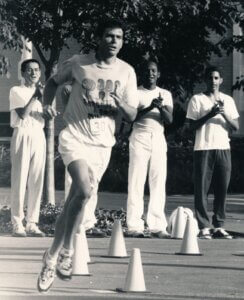
Running one of our many Sri Chinmoy races.
Here I continue with my story of what it was like going to New York to visit Sri Chinmoy twice a year in April and August. Over a thousand students from around the world would gather for two weeks of spiritual festivities. It was an amazing experience. Go back to Chapter 8, the previous blog, for an introduction to this topic.
I was running as fast as I possibly could. I had logged my training miles during the summer and was in the best shape of my life. Now, my legs felt powerful and swift as the soles of my shoes clawed at the quarter-mile track. Sri Chinmoy had called for the first race of the morning to be a three-mile race. New York in August can be notoriously hot and humid, but it was still early in the day, 7:15 am, and the air was cool. The function the evening before had ended at 2:30 am, but we were already on the track for the start of a daylong competition – welcome to Sri Chinmoy’s August Celebrations in the early 80’s! Although Sri Chinmoy, whom I had come to call “Guru,” had just turned 50, he was keeping himself and us going at a relentless pace. Guru needed only an hour of sleep a night, so he felt rested, but that was not the case with me.
But despite my lack of sleep, fortune was with me that morning. I moved to the front pack at the start of the race and stayed there, keeping pace with the fastest runners. I remember being surrounded by the sound of heavy breathing as we all labored to keep pace. I, too, was breathing deeply, intensely, but in a very controlled manner. Because my legs felt strong, I knew I had a chance to win. If I could stay with the leaders until the last 300 meters, I could out-kick them to the finish line.
The night before, I had dreamt I was watching a disciple set a Guinness World Record. (I think two to three Guinness World Records were set by disciples during that Celebration.) In my dream, watching this disciple break his record, I realized I had the same aspiration, determination, and capacity within me. I also realized I could access that aspiration and capacity if I wanted to.
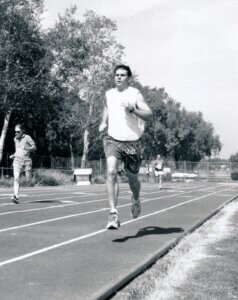
Sujantra in full stride sometime in the early 2000s at a Master’s Track and Field Event in Los Angeles
As we entered the last 400 meters of the race, I suddenly felt myself become very light. It seemed to take little or no effort to propel myself forward. At that very moment, I remembered the dream and somehow knew I was going to win the race. From that point on, the race seemed to unfold before me like a dream. I made my move with 300 meters to go, and no one was able to stay with me. I felt as if I were running on a cushion of air, lifted up and propelled forward by my steady, well-controlled breath. They say the great god Vishnu sustains the world by dreaming the world’s existence. In the final 200 meters of that race, I felt I was doing the same thing, and I did, indeed, win that race!
The Tennis Court
In the mid-1980s, the evening functions of Sri Chinmoy’s New York Celebrations took place in the auditorium of public school PS 86. Guru would eventually move those functions to the tennis court because the school began charging us too much for using the facility. By then, Guru had already named the tennis court ‘Aspiration Ground.’
One of the energizing, yet often uncomfortable, aspects of having functions at the tennis court was that we sat outside and were subject to the elements. On a warm summer evening, sitting with Guru in the fresh air, surrounded by a grove of beautiful trees, was a blessed experience.
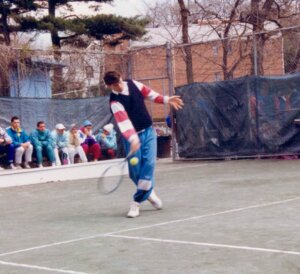
Here I am playing tennis at Aspiration Ground in the early 1980s.
During the day, Guru played tennis with the disciples, especially the top dozen players on his ‘tennis ladder.’ The top players were determined by tournaments. If you were on the ‘tennis ladder,’ you got to take turns playing with Guru. In the midst of all this activity, Guru would take breaks to write poetry, teach the disciples new songs he had written, or welcome visitors to Aspiration Ground. It was a whirlwind of activity.
Every April and August, the Sri Chinmoy Celebration had a ‘California Night.’ This was the night the California disciples sang, performed music, and put on plays. The other disciples looked forward to this evening because of the creativity that naturally springs from the California consciousness. The San Francisco boy’s plays were often the most extravagant and creative of the year. Although it was before my time, I have seen films of the incredible creativity put forth during the New York Celebrations, especially to commemorate the Jharna Kala anniversary.
‘Jharna Kala’ was the name Guru gave to his paintings. One of the amazing things about Sri Chinmoy’s life was the outpouring of creative energy he put into his artwork. Even more amazing is the short span of time in which he painted so many of his paintings. He created 100,000 paintings in his first 10 months!
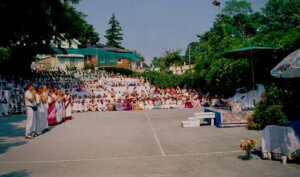
This is Aspiration Ground, the tennis court where Sri Chinmoy (under the umbrella) is thanking a group of disciples for service to their communities.
I remember one evening at Aspiration Ground, a group of young girls from Eastern European countries performed. One of the young performers was a flutist who was studying at the musical conservatory in her hometown. The following afternoon, Guru gave a short concert where he played various instruments. One of the instruments was a flute. After the concert, Guru called the young flutist up onto the stage and gave her his flute. That was classic Guru! No jealousy, only encouragement.
Aspiration
Many disciples felt a strong aspiration to be the very best disciples they could be. Each disciple had their own motives for seeking spiritual progress, and the intensity of our aspiration sometimes added a competitive element to our community. It motivated us to transcend ourselves. Sri Chinmoy, as a true teacher, knew each person’s motivations and helped each to grow in their own unique way.
In one of Guru’s stories, a seeker is looking for the village where a spiritual master lives. In his search, the seeker must make a choice of which road to take. His decision is strongly influenced by his attraction to a beautiful woman. He chooses to follow the woman, and that choice becomes an important step in the journey to find his future master. When the seeker finally finds the Master, he is ashamed that he had been so pulled by his vital passions in making his choice of which road to take. The master explained to the seeker that he used the seeker’s lower vital desire to follow the woman as a means of bringing the seeker to him. It was how he could best influence the seeker’s mind. Guru used our pride, competitiveness, jealousy, insecurity, and human foibles to prod us into action. He moved and transformed our unlit nature into real spiritual growth.
I have always equated aspiration with being diligent in my daily meditation. It was the desire for meditative experiences that brought me to the spiritual life. Guru recommended early morning meditation (preferably at 6 am), a short midday meditation, and finally an evening meditation. Guru’s book, Meditation, gives us much of his meditation advice.
Guru was very clear about the importance of adhering to the lifestyle that he prescribed for us. This included daily exercise. For me, this daily exercise usually meant, among other things, a two-mile run along a beautiful coastline trail in La Jolla. Sri Chinmoy also emphasized living a pure life, eating a vegetarian diet, avoiding non-medicinal drugs and alcohol, engaging in daily spiritual reading, and performing selfless service. ‘Selfless service’ was Guru’s way of denoting an activity that was focused on serving others rather than for personal gain. This included any activity in which time and energy were offered for the sake of others. He often stressed that selfless service was just as effective as meditation in raising one’s consciousness. Guru always stressed that his lifestyle had to be founded on aspiration and inner transformation, not on suppressing the vital or on rigidity in our beliefs. His lifestyle, when lived according to his teachings, created the foundation for a life of abundant energy, unconditional love, and creativity.