PILGRIMAGE BLOG
Sujantra’s Story: Chapter 7 Ivanhoe
Sujantra’s Story
Chapter 7
Ivanhoe
By Sujantra McKeever
By Sujantra McKeever
Welcome to the seventh chapter in a series about my spiritual journey. You can pick up this tale at any point. Earlier chapters may reveal more details about the characters and scenes you encounter in this chapter. Enjoy.
– Sujantra
Ivanhoe
All the strength and succor you want is within yourselves. Therefore make your own future. – Swami Vivekananda
On leaving college, I decided to devote myself wholeheartedly to the spiritual path of Sri Chinmoy. Mahiyan, the Centre Leader of the San Diego Sri Chinmoy Centre, owned a beautiful house on Ivanhoe Street in the idyllic seaside town of La Jolla, in the northern part of San Diego. I made a final romantic break with Ceslie. I knew the lifestyle I was stepping into and wanted to embrace it wholeheartedly. We have remained friends throughout our lives, but the romantic break set the stage for this new chapter in my life.
By the time Sri Chinmoy passed away in 2007, there were over 100 centres in 60 countries. Each was run by a centre leader whom Sri Chinmoy appointed. These centre leaders would report directly to Sri Chinmoy through one of two or three individuals in New York who relayed messages to and from Sri Chinmoy to the various centres around the world. It was an extremely effective way for Sri Chinmoy to stay in direct communication with all of his students. Creating, nurturing, and overseeing his worldwide mission was not a forty-hour-a-week job for Sri Chinmoy. It was a twenty-two-hour-a-day effort. He went into a meditative sleep for about two hours a night and then started up again. If you do a deep dive into all that he did and accomplished in his life, you may think you are reading about the lives of three people. He showed us what we can do if we are laser- focused and don’t need ten hours of sleep a night!
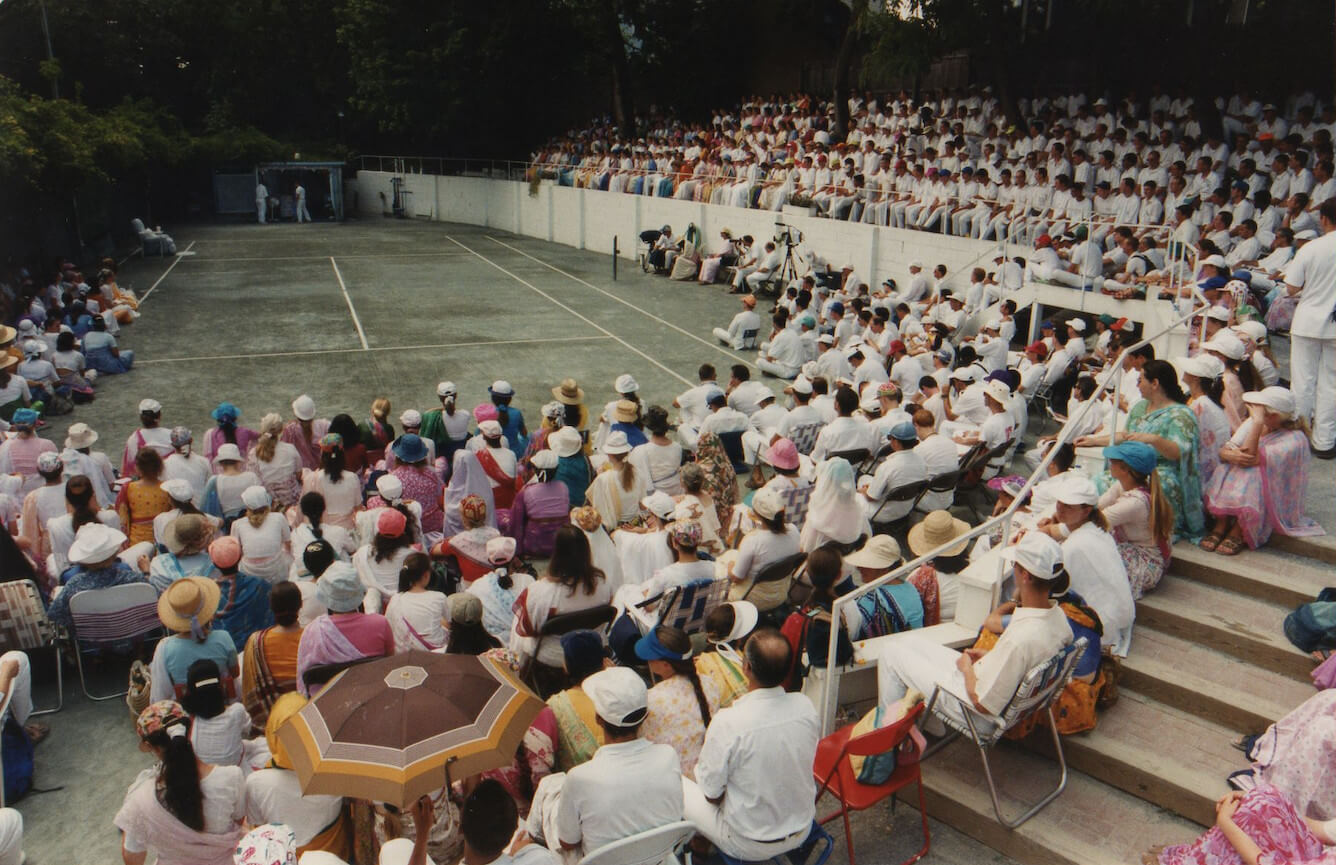
Here’s a picture of Aspiration-Ground, the tennis court/park that the Centre built in the mid 1980s. Sri Chimoy loved to play tennis for many hours a day intersered with working on his writing, music, and art. He would often hold meditation with his students here. When students gathered from around the world this is the morning, afternoon, and evening functions were held.
I was one of six disciples in the La Jolla house following Sri Chinmoy’s spiritual path. There were four single men, each in their own bedroom, and a married couple living in an apartment connected to the house. Together, we formed a community structured by Guru’s lifestyle teachings and spiritual practices. The lifestyle was non-negotiable and had to be agreed upon before joining the community, whether you lived in the La Jolla house or not. The principal rules were celibacy and no dating if one joined single, and no children if you joined married without children. We were essentially a monastic community. Other rules included having a vegetarian diet, non-use of non-medicinal drugs, and no alcohol. Daily meditation and spiritual reading were required. Most importantly, we were to enjoy the fun and bliss that comes through living a pure and dynamic life. In life, many things can weigh us down and unnecessarily bind us to the world. Sri Chinmoy’s lifestyle guidelines were challenging, but they were are also liberating.
Living in a community, we encouraged one another, not just with words, but by the way we lived. Everyone’s focus in life was their spiritual growth. I had just brokenup with Ceslie. Previously, I had never seriously considered a celibate lifestyle for myself. I was familiar with the concept only through the religious orders of the Catholic Church and my readings of books by Zen teachers. With this knowledge and some additional reading, I was able to embrace the discipline. Based on the spiritual experiences, I was having, I decided that the trade-off was worth it. Sri Chinmoy put a great deal of emphasis on living a ‘pure life,’ so I decided to give it my best effort for six months. The breakup with Ceslie gave me a new focus, but I was not sure it would be a long-term one! I knew I could move out of the La Jolla house and go back to school if things didn’t work out. Sri Chinmoy supported this trial approach in his writings. He said in the beginning, the disciple tests the master, and the master tests the disciple. I wanted to give a wholehearted test to the master’s teachings. After all, he was talking about access to cosmic consciousness!
Aspiration-Fire
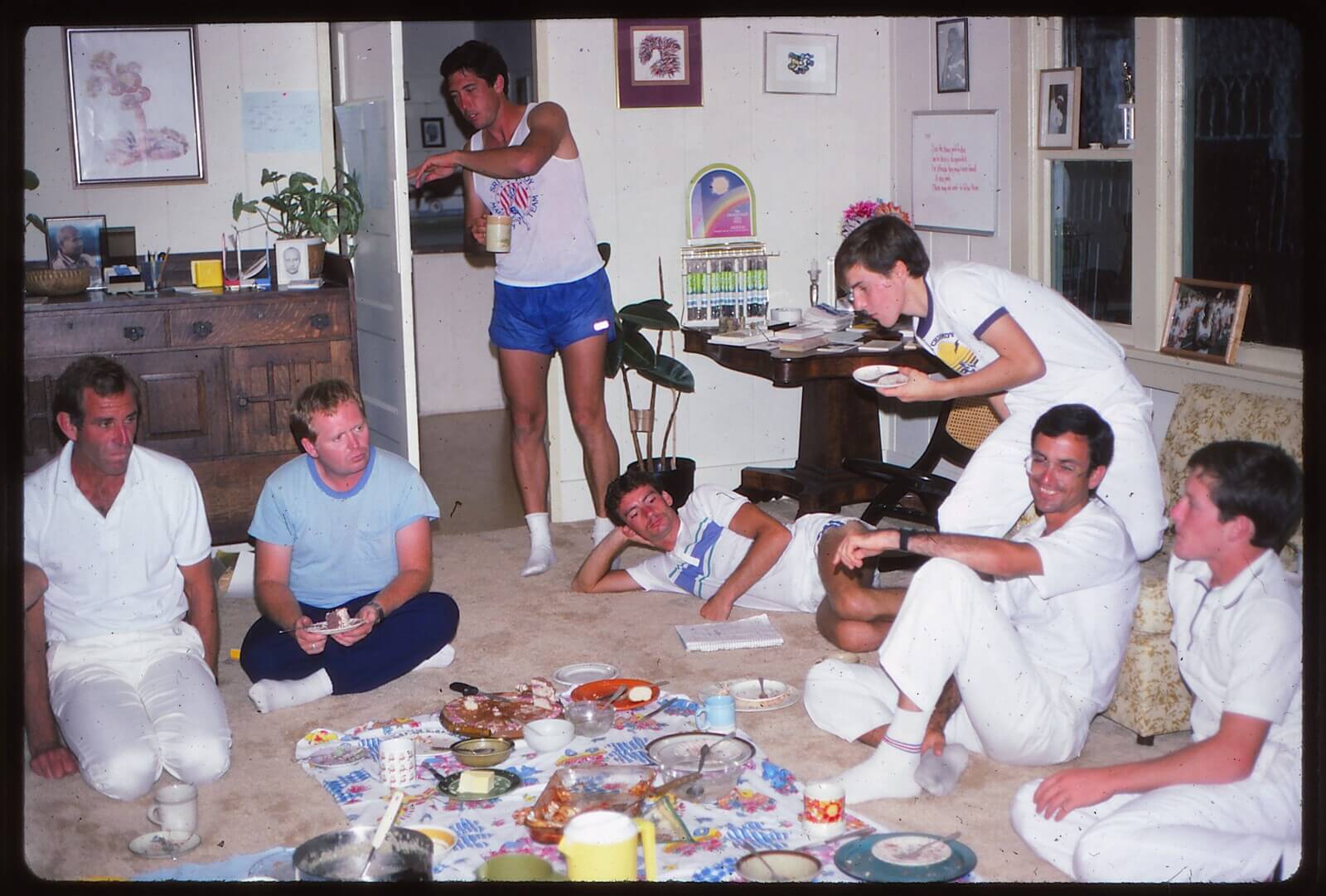
UN Runners at Ivanhoe Centre In the early ‘80s, I organized four relay runs up and down the state of California to celebrate United Nations Day. Here’s a group of runners relaxing at the end of one of our week-long relays. At the UN’s World Headquarters in New York, Sri Chinmoy lead meditations twice a week for UN deligates and staff.
Sri Chinmoy often spoke of ‘our’ lifestyle and ‘our’ way of life. He wanted his disciples to embrace his vision of experiencing and manifesting a higher consciousness. The great benefit of Sri Chinmoy’s path is the satisfaction that comes with a life of aspiration rather than the frustrations that come with a life of desire. Guru once said his role was to awaken his disciples to the living presence of God, for God lives within all hearts. This way of life is based on loving God and expressing that love through inner joy and dedicated service to the Supreme. Sri Chinmoy often used the word ‘Supreme’ in place of ‘God’ because he felt the word conveyed a more intimate and approachable feeling.
Guru was keen to distinguish between joy and pleasure, desire and aspiration. Desire seeks pleasure derived from the physical senses and the possession of objects upon which the senses are focused. Pleasure is fleeting and transitory as the world we perceive is in a constant state of flux. In my meditations, I was searching for an eternal sense of Self, a realm of awareness that supported thought and emotion but was not dependent upon them.Sri Chinmoy used the word Soul to denote this level of awareness that underlies the fluctuations of mind and emotion. Pleasures derived from the physical senses are very powerful, but they are also quite fleeting. Guru put it most concisely when he noted that all sense pleasures are inevitably followed by frustrations because we cannot sustain the experience of pleasure. The person, object, or condition that brought us pleasure cannot be clung to indefinitely. Guru encouraged the acceptance of life, but this acceptance was not for the sake of experiencing pleasure; it was for the transformation of life. Wisdom requires us to use our spiritual discrimination as we move through the world of sensation.
Sri Chinmoy advised his disciples to stay away from aspects of life that did not produce spiritual joy: the killing and eating of animals, the use of alcohol, recreational drugs, and romantic-sexual entanglements. If you came to his path of spirituality and were single, he expected you to stay that way. Married couples were married with the understanding that they would not have children or more children if they already had children.
Spirituality is a lifelong practice. Deep insight does not dawn overnight. Just because I could grasp these ideas intellectually did not mean they were fully integrated into my life. Guru was very aware that the transformation of one’s nature is always a work in process. It is one thing to realize that you are lost in the forest and quite another to find your way out of that massive expanse of trees.
Sri Chinmoy did not expect people to be perfect. He put forth ideals and then worked with his disciples as they aspired to realize their full meaning and
significance. As long as one kept up an honest effort and maintained the aspiration to transcend the temptations of pleasure and the pull of ignorance, Guru was with you. He didn’t expect you to be perfect.
His expectation was simply that you would make a conscious effort to come out of ignorance and aspire for a more soulful existence. As long as one is aspiring and putting forth effort, there is forward movement. When aspiration and effort end, however, it’s another matter. Guru was unwilling to compromise with ignorance. When aspiration and effort come to an end, various life forces, invoked by the disciple’s own choices, would come and move that person out of the community.
Meditation
I was highly motivated to learn meditation. That was the main reason I sought a spiritual teacher. By the time I was 17 years old, I had read over 20 books describing the power of meditation. Many of these books were firsthand accounts of forays into the realm of the mystical via the various techniques of meditation. Iw anted access to that realm of spiritual energy. After meeting Sri Chinmoy, I welcomed the spiritual lifestyle and embarked wholeheartedly on his spiritual path. I was meditating two or three times a day, doing daily exercise, reading his spiritual writings for a half hour each day, and following all of the other spiritual lifestyle recommendations he offered to his disciples.
In that first year of discipleship, I saw that I could achieve the goals that had motivated me to embark on my meditation journey: I had learned to reduce stress, calm my mind, and I had found a deeper sense of self. In retrospect, I think this is the point where many disciples choose to leave Sri Chinmoy’s path, the point at which many spiritual seekers become complacent. They achieve what they want through meditation and decide it is time to move on; often, moving on often means returning to a desire-focused life.
The first year of working with Sri Chinmoy was exciting. In my meditations, I glimpsed energies and realms of consciousness that I did not think were possible. My inner journey was like hiking through a range of mountains: when in the valley, the nearby mountain peak is your only goal, but once you reach that peak, you see there is so much more to the landscape than you had imagined. Each goal reached shows a new peak to summit!
The San Diego Sri Chinmoy Centre
Our meditation Centre was on Ivanhoe Street in La Jolla, California. Mahiyan and I had bedrooms on the second story. Papaha and three other male disciples lived on the ground floor. A married couple lived in the attached apartment. We all had daytime jobs. I worked as a dishwasher in a local restaurant, Papaha attended a local university, and Mahiyan owned a tennis shop, which he eventually sold to get the money to open a restaurant that Sri Chinmoy named Jyoti Bihanga. Jyoti-Bihanga is Bengali. The translation is, “The soul-bird of the Absolute Light Supreme!”
In college, my parents supported me financially. When I decided to leave college, they wisely cut the purse strings. I can say “wisely” now, but at the time, it was a big reality shift for me. In the past, whenever I needed money, it was there for me. Now, suddenly, I was living hand to mouth. In my dishwashing job, I was able to make just enough money to pay my rent, eat, and save a little for trips to see Guru. Until we opened Jyoti-Bihanga in 1986, I supported myself through restaurant jobs, a car wash I opened, and teaching tennis. I had learned I could support myself as long as I was willing to wash dishes, mop floors, and seize opportunities when they appeared.
Each evening, at Ivanhoe, we would meet in the meditation room, which was a converted living room. There, we would meditate for an hour. I found that meditating with the group inspired me to deepen and solidify my personal meditation practice. After meditation, we had dinner.
Each night of the week, it was a different person’s responsibility to prepare dinner. We ate together on a large tablecloth spread out on the floor. My night to prepare dinner was Mondays. My culinary skills and my budget were quite limited, so I often made spaghetti. Following dinner, we would all pitch in to do the dishes. After dinner, we would all participate in a spiritual activity for one to two hours. Each night there was a different creative activity that was rooted in Sri Chinmoy’s teachings. There was a spiritual reading night, a play night, where we would practice performing one of Sri Chinmoy’s plays; musical instrument night and singing night, both focused on Sri Chinmoy’s music, a movie night where we would watch inspiring ilms; and there were two formal Centre meditation nights on Wednesday and Sunday. There was also a Sunday morning meditation, which
was my favorite because I always had my best meditations in the morning when I was fresh and wide awake.
At that time, the Internet didn’t exist, and Mahiyan didn’t allow any television watching. That was a rule for which I am, in retrospect, most grateful. As a result, this was a creative, peaceful, contemplative, and formative time in my life. The first public event we sponsored as a Centre, besides our meditation classes, was a kite regatta. I think we called it the Freedom Kite Regatta. I remember twenty or thirty people showing up to fly kites.
In the early nineteen eighties, Guru was running and playing tennis. Mahiyan, at one time, was number one in the tennis rankings in San Diego and had even played in the French Open. In New York, he would play tennis with Guru for hours on end. In San Diego, he played with us for hours and hours as well. Mahiyan truly loved tennis, and because of his enthusiasm and self-giving, many California boy disciples became good players. Playing tennis became one of the focal points in my spiritual life. Sri Chinmoy taught that with the right focus, almost any activity could become a vehicle for spiritual growth. He taught that practicing and competing in sports is an opportunity to learn about oneself and have fun. Too often, we forget to play and enjoy life. Sports is a way to stay active, focused, and joyful.
These were indeed idyllic times! My life was well-focused on spirituality both outwardly and inwardly. A new world was awakening within me. My meditations ere becoming deeper, and I was experiencing realms of consciousness beyond anything I had experienced before. I was living a spiritually focused life and loving it!