PILGRIMAGE BLOG
Kant, the “Thing-in-Itself,” and the Yogic Path to Reality
By Sujantra McKeever, Pilgrimage Staff
This article explores the intersection of Western epistemology and Eastern spirituality by examining Kant, the “Thing-in-Itself,” and the Yogic Path to Reality. It begins by detailing Immanuel Kant’s revolutionary argument that our minds construct a “phenomenal” world of appearances, forever separating us from the “noumenal” reality of things as they truly are. While Kant identified the mental filters that limit our perception, the practice of Yoga provides the practical tools to quiet the mind and transcend these boundaries, eventually moving the seeker toward a direct, unmediated experience of existence.
Introduction: The Architect of the Modern Mind
Immanuel Kant (1724–1804) is a central figure of modern philosophy. He shifted human inquiry from objects we observe to the mind that observes. Before Kant, philosophers mostly debated how we perceive the external world. Kant claimed the mind is not passive, but actively builds experience.
In building on his philosophical foundation, Kant drew a revolutionary boundary in Critique of Pure Reason and Prolegomena to Any Future Metaphysics, distinguishing sharply between the world as it appears to us and the world as it actually is.

“The world we know is not the world as it is; it is the world as it is constructed by our minds.” Immanuel Kant, Critique of Pure Reason
The Great Divide: Phenomena vs. Noumena
Kant’s philosophy hinges on the concept of the “Thing-in-Itself” (the noumenon). To understand our place in the universe, we must distinguish between two distinct realms:
- The Phenomenal World: This is the realm of our everyday experience. It is the world of sights, sounds, and textures—a world filtered through our human senses and mental faculties.
- The Noumenal World: This is the realm of things as they exist independently of our perception. It is the objective reality that sits behind the “curtain” of our senses.
According to Kant, our knowledge is strictly limited to the phenomenal. We can never truly “know” the noumenal world because the very act of perceiving it changes it. This resonates deeply with The Stanford Encyclopedia of Philosophy’s analysis of Kant’s Transcendental Idealism, which explains that space and time are not properties of the world, but rather the “software” our minds use to organize data.
Reflection 1: Think of a recent conflict and consider how much of that “reality” was based on objective facts, and how much was a “construction” built from your personal history, mood, or expectations.
The Analogy of the Tinted Glasses
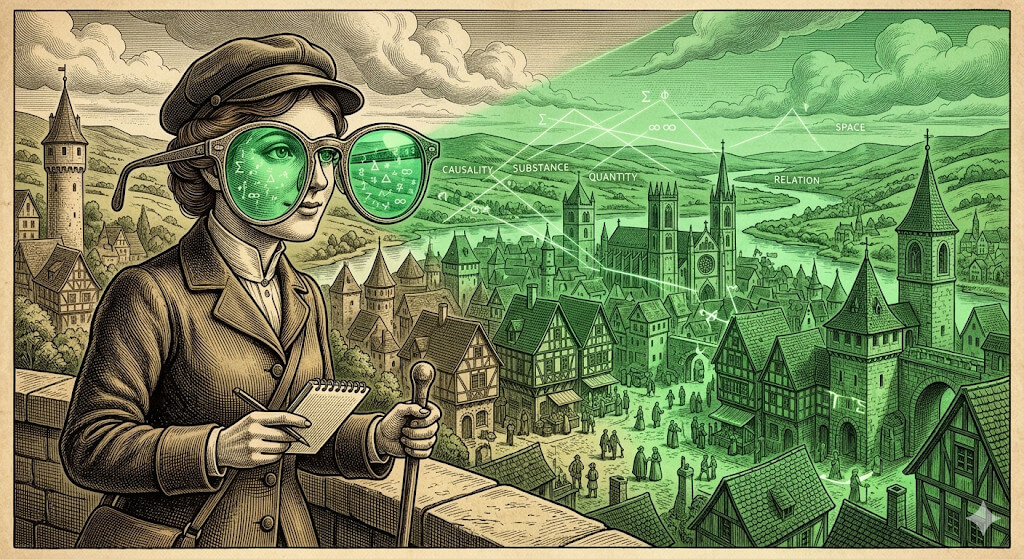
“Our knowledge extends only to appearance, not to things in themselves.” – Immanuel Kant, Prolegomena to any Future Metaphysics.
To illustrate this complex idea, Kant famously compared our experience to a traveler viewing a city through tinted glasses.
If you wear green-tinted lenses, the entire city appears green. You might conclude that “greenness” is a property of the buildings and streets. However, the greenness exists only in your lenses. Similarly, our human cognitive structures—categories like causality, quantity, and relation—act as a permanent filter. We cannot “take the glasses off” through mere intellectual thought because those glasses are our intellect.
This inherent subjectivity prevents us from directly accessing the “true colors” of the objective world. For a deeper look at how these filters function in modern psychology, you can explore Simply Psychology’s breakdown of Cognitive Schemas.
Reflective Question 2: If your current mood or “tinted glasses” are colored by a specific emotion today (such as anxiety, joy, or impatience), how is that color physically changing the way you perceive the people around you?
The Indian Spiritual Perspective: Beyond the Illusion
“We can never go beyond the field of possible experience, because every experience has already presupposed it.” – Immanuel Kant, Critique of Pure Reason.
While Kant identified the limits of the human mind, Indian Spiritual Philosophy—and specifically the practice of Yoga—offers a method to transcend these limits.
In Eastern thought, the belief that we have a full grasp of existence based solely on our senses is considered Maya (illusion). Yoga teaches that the “Subject/Object” view of life—where there is an “I” looking at an “Other”—is the primary construction that needs to be unraveled.
The “thing-in-itself” (noumenon) is Kant’s boundary, asserting we know the world only as it appears, not as it exists independently. Our minds act as a permanent filter—like tinted glasses—organizing raw reality into structures like time and space. Because we cannot remove these filters, objective reality remains beyond our grasp. We inhabit a world of appearances, constructed by human mental architecture rather than the world as it truly is.
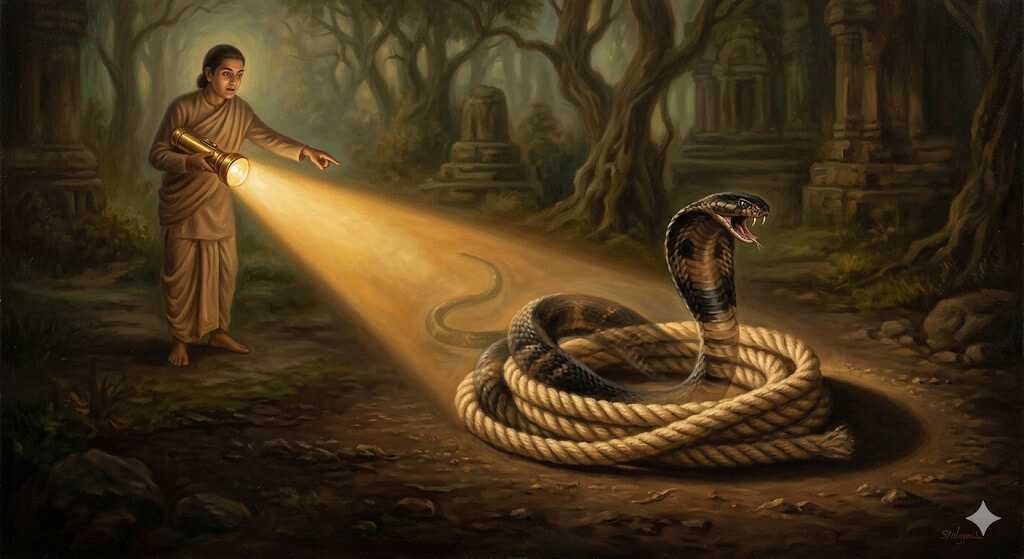
Indian philosophy’s “rope and snake” analogy illustrates Maya, the illusion that obscures this reality. Just as one might mistake a rope for a snake in dim light, we mistake the material world for the ultimate truth. The “snake” lacks objective existence yet dictates our reactions until the “flashlight” of awareness is applied. Yoga serves as this light, unraveling mental constructions so the observer perceives the unified reality that was always there.
When we quiet the mind, we aren’t just relaxing; we are deconstructing the “construction” Kant spoke of. To learn more about how meditation can begin to thin these mental filters, check out the Pilgrimage of the Heart Yoga Blog, which offers practical guides on moving from the “thinking” self to the “observing” self.
Reflection 3: If you were to sit in total silence for ten minutes and strip away your name, your job, your memories, and your plans, how would you describe what remains?
Conclusion: The Horizon of Knowledge
Immanuel Kant gave us the map of the mind’s boundaries, and Yoga gives us the tools to explore the territory beyond the map. By recognizing that we are the architects of our own phenomenal reality, we gain the freedom to renovate that reality.
The implications of the Kantian distinction are profound. It humbles us, reminding us that our subjective perspective is always limited. However, it also empowers us. If the world we know is “constructed” by our minds, then by refining our minds, we change our world.
To see how these abstract concepts are being tested by modern cognitive science, visit The Center for Mind and Brain to explore the latest research on perception and consciousness.
As we unravel the mental constructs that bind us, we move closer to the “Thing-in-Itself”—not through the intellect, but through the silent, expansive power of pure awareness.