PILGRIMAGE BLOG
A Higher Love: Bhakti Yoga and our Emotional Body
By Oak Jackson and Sujantra McKeever
We have all had the experience of “being in our heads” and likely we are at least partially, unconsciously, in that state at this current moment: reading these words, generating thoughts and images, reflecting into the past, projecting into the future, attempting to rationalize some question or answer of the present moment, etc. With access to a “smart” phone and artificial “intelligence” and goaded on by the cultural urgency for the hustle and bustle, we find ourselves effectively hypnotized by the mania of modernity, frequently stuck in intellectual feedback loops and bound to emotional cycles of boom and bust. How do we disconnect in order to reconnect?
Recently Sujantra gave a talk during his Journey to Awakening series on the subject of emotional response and expansion through the practice of Bhakti Yoga: the yoga of love, surrender, and devotion. As Sujantra reminds us, when we study meditation as part of our yoga practice it can start to feel intellectually heavy with so many teachings concerned with the mind (In fact, only 3 of Patanjali’s yoga sutras comment on our emotions, the vast majority of them concerning our thoughts). Yet the practice can also be as simple as cultivating gratitude, love, and compassion as a means of getting out of our minds and into our hearts. In this article we’ll unpack the practice of Bhakti yoga while exploring some illustrative stories to dive deeper into understanding the value of our higher emotions.
Being in Our Hearts
When asked which commandment was the most important, Jesus replied “To love God.” For the ancient Greeks love as a concept was defined by at least eight separate words and intentions, everything from eros (desire) to philia (friendship) and most relevant, agape – an unconditional and universal love. Such a love transcends our baser emotions and our attempts at explanation by connecting us to something larger, something enduring, something outside ourselves, immediate and omnipresent. Another Greek word, ekstasis, meaning to stand outside, which we adopt as ecstasy, is that uncanny experience of feeling an overwhelming connection to something greater and beyond any attempt of rationalization.
Thus, the goal of Bhakti yoga is to consistently cultivate such a love grounded in ourselves through practices of devotion which ultimately extend beyond ourselves. Here Sujantra introduces a helpful Sanskrit term, bhavas, meaning “to be” but also referring to our emotional state. Take a moment just to appreciate how you feel without wondering why. Since thoughts typically follow feelings in response, it is helpful to practice awareness of our own being by being aware of our emotional state without judgement. Accordingly, we can affect a transformation of our thoughts and feelings by mindfully being grateful, compassionate, and returning ourselves to that state of grace persistently available to us – a moment of forgiveness, clarity.
Going Beyond the Horizon
Once upon a time Sujantra was quite the hoops player, and being a basketball player was a big part of his identity rolling into high school. One day, the coach decided unfairly to cut Sujantra from the team, thus taking away that attachment to identity that Sujantra was familiar with. This is an example of ego death, the catastrophic reduction of our identity brought about by sudden and overwhelming change. Initially this would have resulted in damaged emotions, and from that bhavas it does not take long to start generating angry, reactive thoughts. On reflection, however, Sujantra shares that the decision might well have been in his best interest; to be so focused and attached on a singular, conditional, identity narrows the horizon of what’s possible in life, and by losing that identity as a basketball player, Sujantra was freed up to explore more of life and to expand his options.
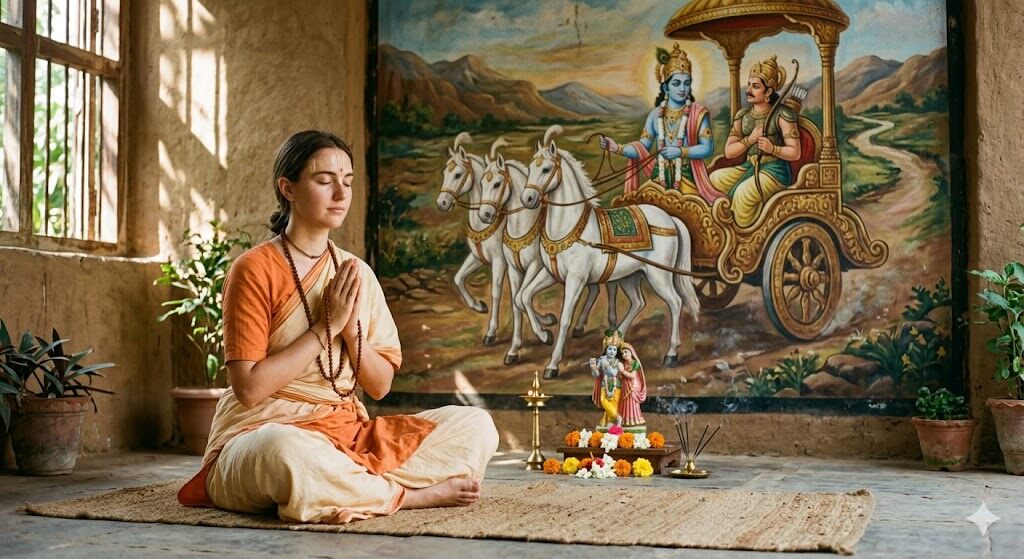
Let’s pause to reflect on ourselves in light of this story, and maybe upon a time in our own lives when something was taken away from us, how we felt, what we thought, and how that change maybe brought us closer to something else, something more. There is a tale of Krishna and Arjuna travelling as humble monks, spiritual seekers out on the road, and one day they are taken in for refuge by an old woman. This old woman was very devout in her devotion to God, and was quite generous with Krishna and Arjuna despite her humility, having little more than a cow and a roof over her head. She was so generous and hospitable that upon departure Krishna decided to grant her a great boon – to kill her cow. Perplexed, Arjuna asked Krishna the meaning of granting such a gift, Krishna replied “She is so close to God, in her devotion and humility, that to take away the attachment to the cow will now bring her even closer still”.
Learning to Surrender
It is better to have loved and lost than never to have loved at all – Tennyson
As we learn from the yogic philosophy, our attachments are the causes of our suffering, but what is the cause of our joy? Is it just the thing itself, or can we learn to hold loosely to our attachments? With experience we realize that all the suffering locks us up in a loop: while thoughts spiral out and the body seizes up with raging emotions, we contract, we withdraw, we decline, and so on. The antidote begins in a concerted effort to be aware of what we are experiencing, our bhavas, what we are feeling, and choosing to make the object of our focus love and gratitude despite the circumstances. In doing so, we shift from negative to positive, and then we go further by putting that focus, grounded in love, upon an object outside ourselves – ekstasis. By devoting ourselves to something larger and outside ourselves we extend beyond our personal suffering and expand the horizons of what’s experientially possible. This is Bhakti.
In conclusion, let us meditate on the idea of surrender. Some of us will have a gut reaction to the thought of submission, but let’s expand and review the word surrender through a spiritual lens. We can acknowledge the value in developing personal awareness and responsibility for the Self, we can also acknowledge the value in grounding ourselves in something larger outside ourselves (not as a personal attachment, but as a lack of personal attachment). What if we gave ourselves permission to remain open to the universe, if we gave permission to the universe to open ourselves.. “To let Jesus take the wheel” expresses this idea of surrender as a form of trust in the best intentions of life which is the essence of Bhakti yoga: to find meaning in our suffering as fuel for our growth, to devote ourselves to a life rooted in love and compassion, and to expand the experience of our lives through the practiced engagement of our higher emotions and intentions.