PILGRIMAGE BLOG
Sujantra’s Story: Chapter 17 Jyoti-Bihanga
Welcome to the seventeenth blog in a series about my spiritual journey. You can pick up this tale at any point. Earlier blogs may reveal more details about the characters and scenes you encounter in this blog. Enjoy. –Sujantra
Chapter 17
Jyoti-Bihanga
I slept and dreamt that life was joy. I awoke and saw that life
was service. —Rabindranath Tagore
The Soul Bird of the Absolute Light Supreme
Right from the beginning of our Centre, in 1979, when he first became a disciple, Mahiyan always talked of opening a restaurant. One day, Guru asked him to do just that. It took more than a year to find an acceptable location. That was fifteen miles to the south of La Joelle, in an historic neighborhood of San Diego called Normal Heights. Mahiyan signed the lease on the building in 1985, but it took us a year to transform the space into a working restaurant. By the time Jyoti-Bihanga was ready to open, I had decided to stop teaching tennis and work there full-time. Guru gave our enterprise the name Jyoti Bihanga, which means “the soul-bird of the Absolute Supreme.”
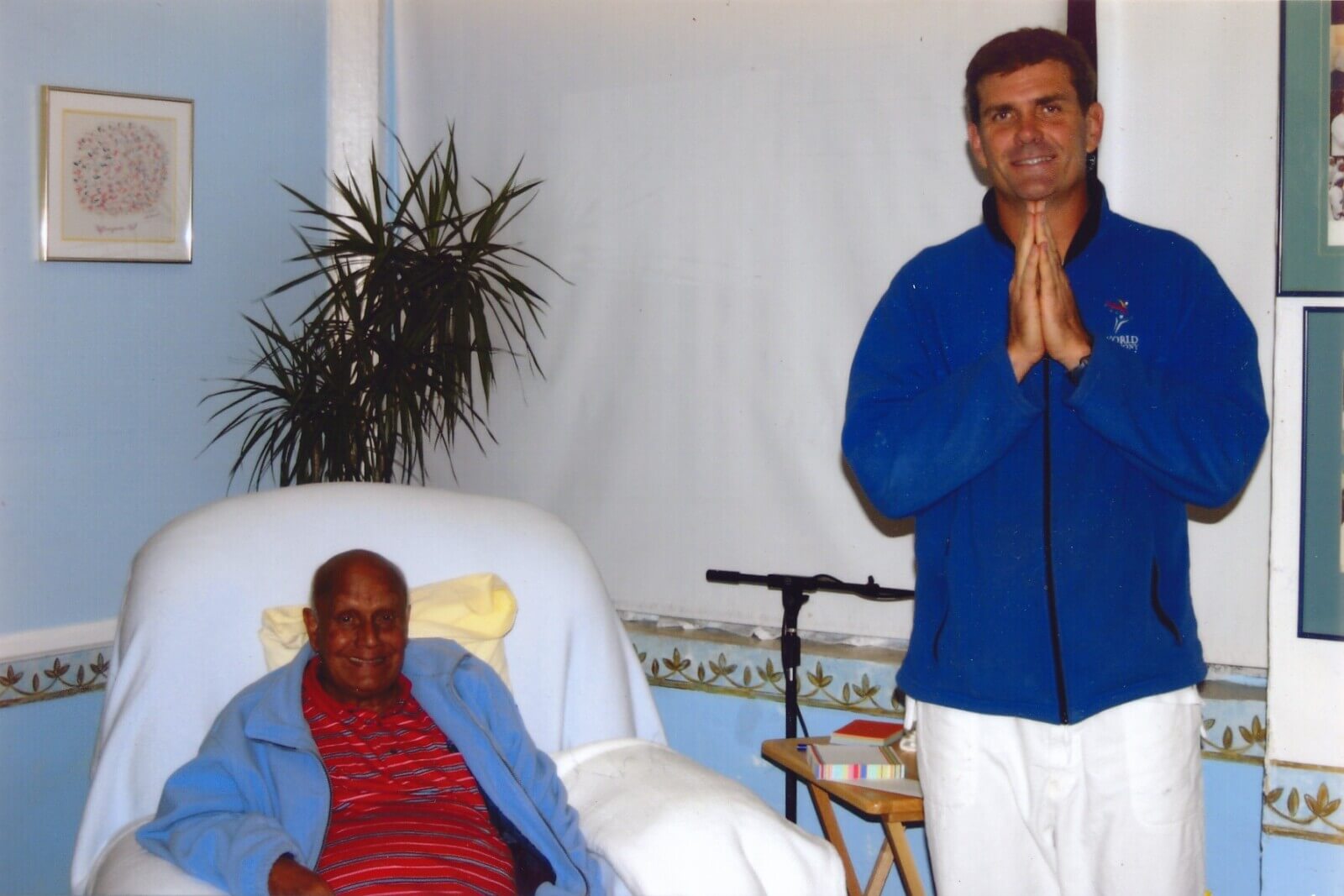
Sri Chinmoy and Sujantra at Jyoti Bihanga
Mahiyan had previously owned a successful and well-known tennis shop. He started the business after graduating from the University of California, San Diego, with a degree in Physics. Mahiyan was very confident in business and in any matter dealing with numbers and money. To finance Jyoti-Bihanga, Mahiyan had to sell the house in La Jolla that had served as our Centre and home. The disciples moved into apartments and houses in Normal Heights. I lived with two other boy disciples in a two-bedroom apartment that had a large garage. Papaha converted the garage into a combination art studio and living space.
I must admit the move from La Jolla was a challenge for me. I missed living by the ocean and the daily communion with nature that coastal living provides. I also missed living in the Center with many other disciples, which allowed me to connect with those in a similar state of consciousness. I had my own room, so I could always close the door and meditate alone. This helped me go through the various moods and inspirational cycles we all have.
In the early 2003 when we were looking for a more suitable place to house our Centre, Guru said Mahiyan and I could live in it. The place we found had just one living space, so Mahiyan, being the Centre leader moved in it. I think Guru liked the idea of someone living in the Centre. It brings a living energy to a place. I am reminded of the temple priests in India who live at the temples.
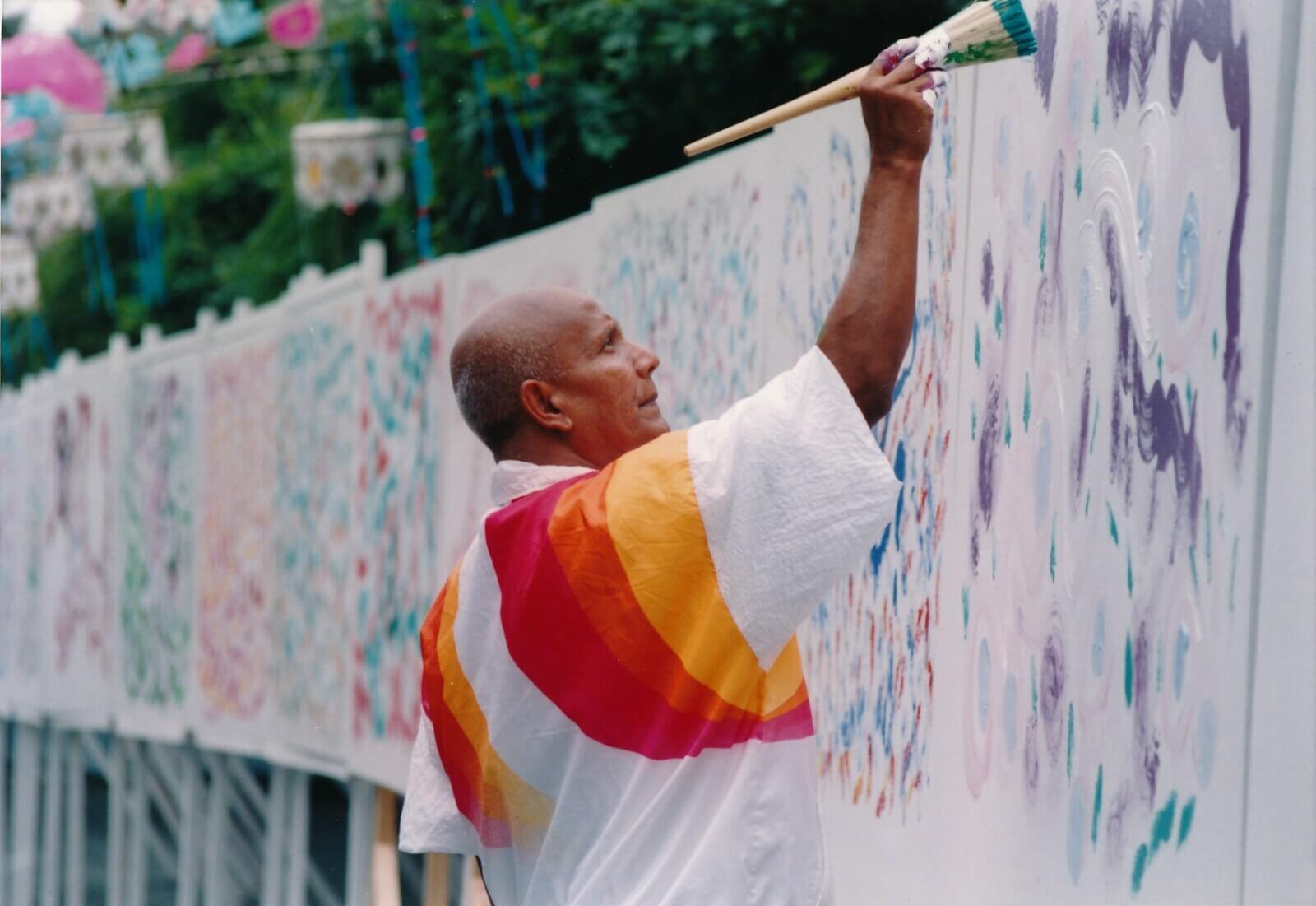
Sri Chinmoy Painting
In 2004, after my mom’s passing, other disciples and I made a 17-day visit to India. At Dakshineswar, the Kali temple where Ramakrishna lived and taught, I saw the small bedroom where Sri Ramakrishna lived. It was tucked into a corner of the temple complex dedicated to Kali. Seeing that small living space reminded me of Guru’s idea of a living presence in some of the Centres.
As it turned out, all eight of the disciples living in La Jolla moved to Normal Heights and committed themselves to working at the restaurant. I worked from 7 am to 3 pm Monday through Friday. From 7 am to 10: 40 am, I did the food prep. I made the salad dressings and cornbread, stocked the cooking line, prepared the vegetables for cooking, made the baked potatoes, and made the tabouli and other side salads. After that, I got a 20-minute break, when I usually went to a back room and took a twenty-minute meditation-break-nap. This was when I learned yogic napping. I was able to completely focus on my breath and fall asleep within seven breaths. I napped when I was exhausted and needed to ‘check out’ from reality. On other occasions, I meditated. After my break, I would wait tables from 11 am to 3 pm.
I really enjoyed my job because the morning hours were very meditative, at least when we weren’t competing (In Guru’s spirit of self-transcendence) over who could prepare the cornbread the fastest. At the beginning, my cornbread prep time was 17 minutes. Three of us competed for the fastest time, and by the end of the second week, the best time was down to 3.5 minutes! At the other end of my schedule, my shift as a waiter was both social and soulful. The Sri Chinmoy Centre and Jyoti Bihanga were becoming a vibrant part of the local community.
The opening of our restaurant ushered forth a new and significant chapter in both my spiritual journey and that of the San Diego Centre into which my life was now integrally woven. Between 1986, when the restaurant opened, and 1989, when Guru came to San Diego to perform in a concert for 4000 people, our centre doubled in size. Each of the disciples was discovering new capacities, and we were getting disciple visitors from around the world, especially between the April and August Celebrations.
I often describe working in a Divine Enterprise as being in a mystical fire that can turn lead to gold. The ‘fire’ was the low wages and being constantly asked to sacrifice your personal desires for the good of the business. In this environment, some disciples flourished while others didn’t. Those who stayed were forged into stronger disciples. Mahiyan often asked Guru management questions, so Guru was constantly making decisions that affected everyone’s lives. I saw in this an unprecedented opportunity for spiritual surrender.
It is one thing to read spiritual texts that theorize about spiritual growth and progress. It is an entirely different experience to work with other human beings to keep a restaurant open while keeping spiritual energy at the forefront. Guru always said that for his disciples to achieve his vision of true spiritual progress, there would have to be a transformation in every part of their being. There were, inevitably, arguments, disagreements, and disappointments, as well as triumphs; but in the end, for those who persevered, each shift dissolved into the peace and calm of meditation on the Transcendental.
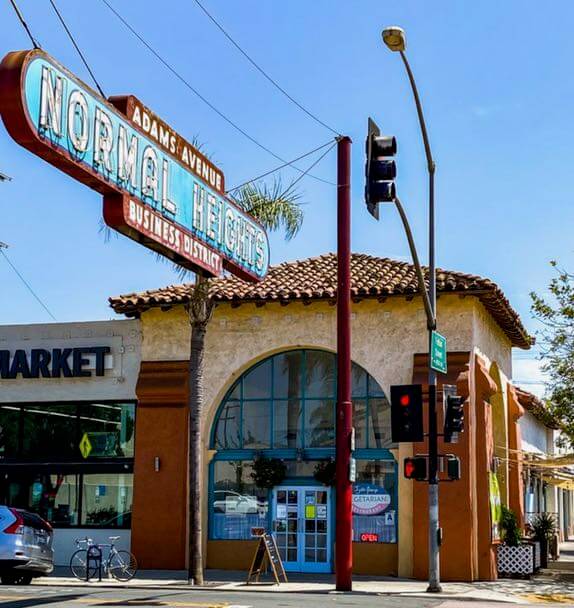
Jyoti Bihanga as it looks today
Jyoti-Bihanga averages between one and two hundred customers a day. That means over a hundred people a day sitting for an hour or more inside Guru’s manifestations of music, art, books, photographs of Guru, videos of Center activities, and being waited on by disciples. This has the potential to significantly impact people’s consciousness. As of 2015, Jyoti-Bihanga has been in business for 38 years, and wherever I go in San Diego, I meet people who love the restaurant.
I met a young couple at a spiritual festival where my yoga studio, Pilgrimage of the Heart, had a booth. We were selling Guru’s books and CDs. This couple were frequent diners at Jyoti-Bihanga. The young woman noted that every time she left the restaurant, she felt so happy afterward. She kept telling her boyfriend that it surely must be something more than just the food. She asked if we prayed, meditated, or did any other activity while creating the food. I explained to her that her intuition was correct; she had become conscious of the divine light and intention that gave rise to the restaurant.
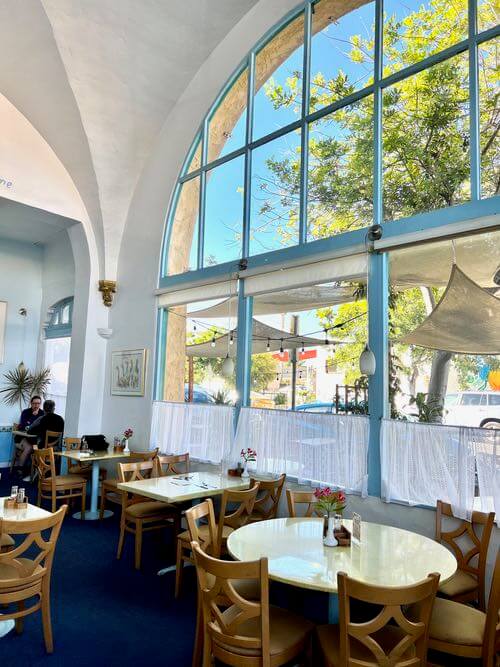
The dining room of Jyoti Bihanga
We encounter many spiritual battles in life, inner battles, as we seek to transform our lives. The restaurant also has a life, a reality, and a soul that undergoes transformations. It too must adapt to change and grow to meet the challenges of the economy and the ever-changing appetites of its customers. All involved with the restaurant are part of this transformation.
The opening of Jyoti-Bihanga brought a new dimension to my spiritual life. Suddenly, there was a tangible entity to which one’s personal desires would need to be sacrificed. It is one thing to theorize about community and oneness; quite another to bring that dynamic into your day-to-day existence. This is the opportunity that Jyoti-Bihanga creates for the disciples in San Diego.