PILGRIMAGE BLOG
Sujantra’s Story: Chapter 20 Using Power Wisely
Welcome to the twentieth blog in a series about my spiritual journey. You can pick up this tale at any point. Earlier blogs may reveal more details about the characters and scenes you encounter in this blog. Enjoy. –Sujantra
Chapter 20
Using Power Wisely
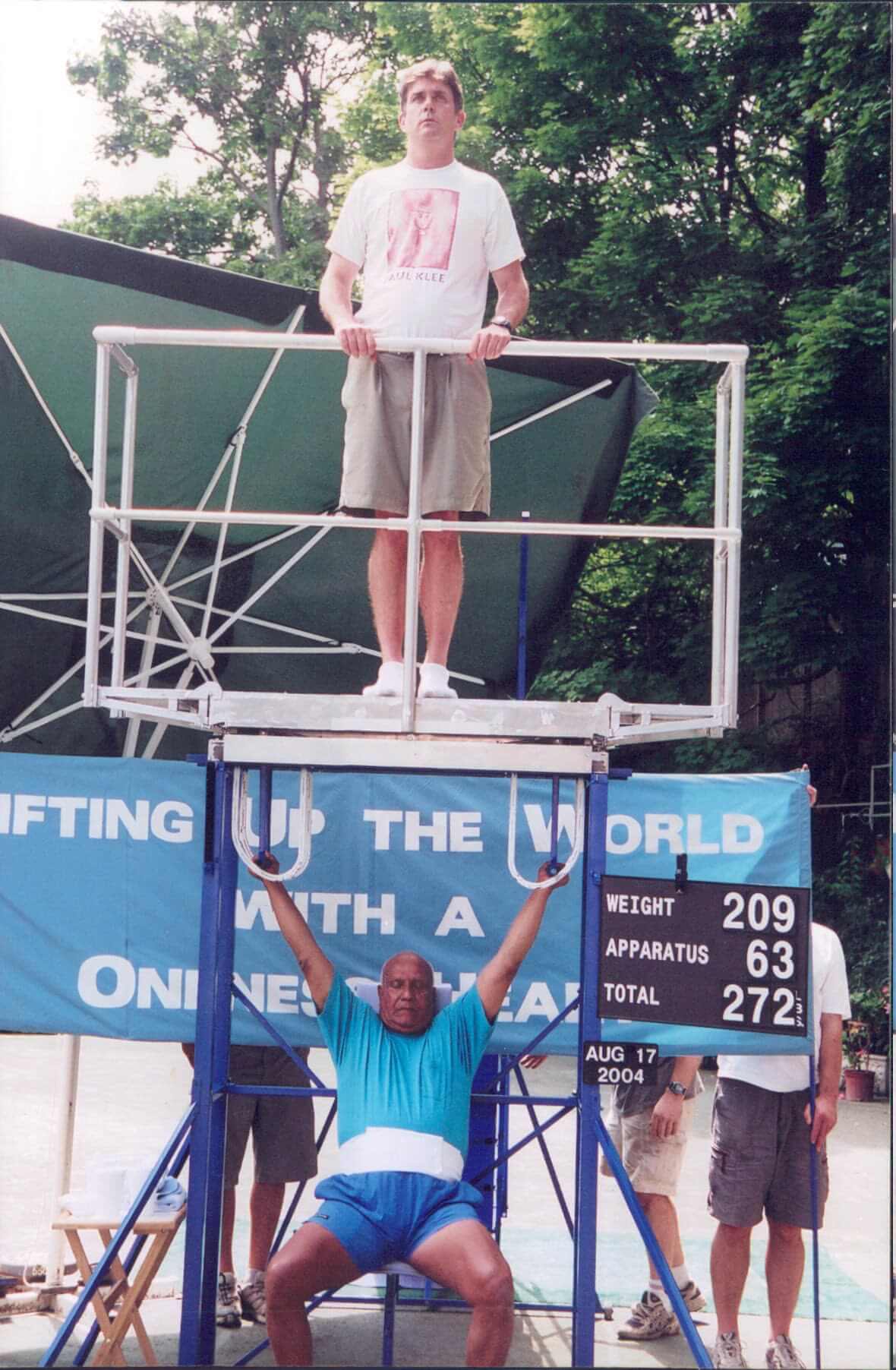
Sujantra being lifted by Sri Chinmoy
From Sri Chinmoy, I found access to an incredible creative force, but as he often said, “With a knife you can either cut a piece of fruit and share it with others, or with that same knife you can harm others.” Visualization in manifestation is just like that knife. It can have different effects. It is important to use the power of visualization wisely. That’s a challenge I constantly face.
It’s like being in a very lucid dream. If you become aware that you are dreaming, then you can do anything you want, because you know you are the creator of your reality. In your ‘lucid dream,’ you can choose to experience innocent joy or any base pleasure the mind can conceive. That is the challenge that faces those who manifest, whether in lucid dreams or in this waking life.
After working for many months on a particularly powerful manifestation project, after seeing it through from inception to completion, I realized I could manifest whatever I wanted. It was simply a matter of concentration. I could choose to open restaurants and yoga studios, put on meditation workshops, orspread the Light of the Supreme on Earth. Alternatively, I could focus on personal gratifications. I could choose to make myself a multi-millionaire and to enjoy all the pleasures that this world has to offer. I think each individual eventually finds him or herself standing on a mountaintop, just as Jesus did. There, the pleasures of this world tempt us to give up our pursuit of the Transcendental Experience.
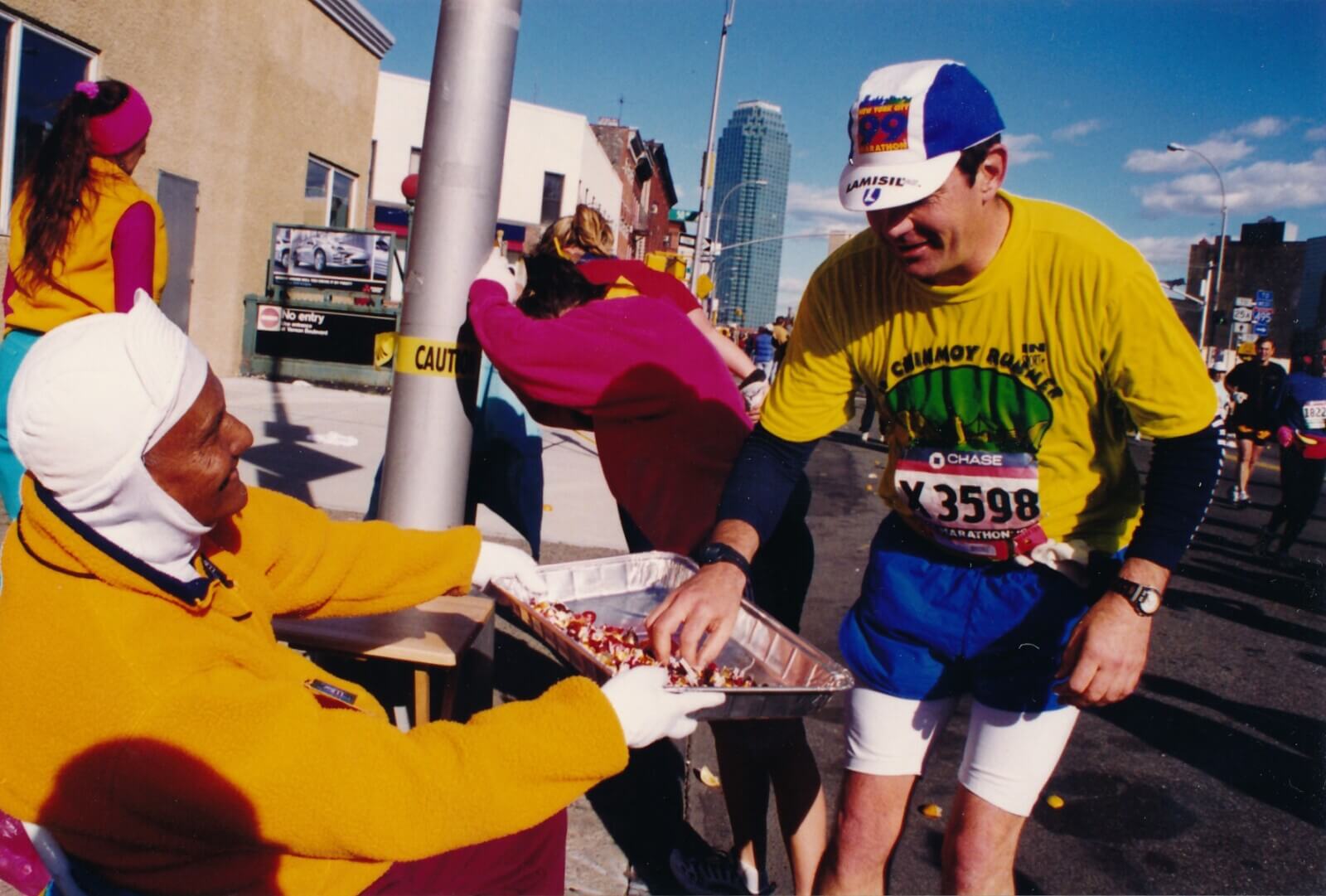
Sujantra running the NYC Marathon receiving refreshments from Sri Chinmoy
This theme of temptation runs throughout mystical literature. One of the classic Indian stories is of a great yogini who meditated in the forest for many years, most soulfully and devotedly. The gods were deeply moved by her prayers, and Brahma himself, the Lord of All Creation, descended to Earth and assumed the form of a luminous being. He appeared before the yogini and offered to grant her any boon she desired, to reveal to her any secret of the universe, any experience or material object she might want.
Now, imagine yourself in that situation! What would you ask for? Fame and fortune, knowledge of where the stock market is headed? Would you rather know the future or the secret thoughts of others? This great yogini replied, “I wish to know that by which knowing all else is known.” She wanted the essence of life. That is the challenge we all ultimately face. It is the challenge to go into the very heart of existence and not to be distracted by other things, which are transitory.
This challenge confronted me at the end of every big manifestation project. Unfortunately, I sometimes chose the world and its pleasures. Alas, the lessons we all need to learn! Ramakrishna constantly warned his disciples of the temptations of worldly pleasure and power. The closer to the Source a temptation is, the more powerful its force.
Sujantra running the NYC Marathon receiving refreshments from Sri Chinmoy
In 1989, I organized Sri Chinmoy’s Peace Concert at Golden Hall in downtown San Diego. For nearly four months, every day looked like this: Get up at 6 am and meditate for 30 minutes. (This is the time prescribed by Sri Chinmoy for his students.) Then, from 7 am to 3 pm, work at our vegetarian restaurant, Jyoti-Bihanga. After work, go home, take a 30-minute nap, wake up, and go for a 2-mile run (the distance Sri Chinmoy suggested all disciples run or walk each day). After that, do a 30-minute meditation in the evening, then work on the concert from 5 pm until 11 pm.
Looking back, I must say that that was one of the most empowering times of my life. I developed skills that would serve me for a lifetime: graphic design, marketing, public relations, and project management. On a side note, I feel the challenge of marketing Sri Chinmoy and his philosophy boils down to connecting his height with the aspirations of the general public. If you can market that, you can market anything!
After that concert, I felt I could do anything. I spent the next three months studying for a real estate license, with the goal of pursuing a lucrative career in that industry. I received my license and was out looking for a job when I got an interview with a broker who was familiar with Jyoti-Bihanga. This gentleman took a good hour out of his day to really break down the lifestyle that I was about to step into. He suggested I think deeply about the career I was pursuing.
I took his advice and spent the next week meditating on the questions raised by that interview. I knew in my heart I wanted to focus on organizing events for Guru and the centre, and I finally decided it would be better if I didn’t go into the real estate business. In the end, I was able to use my knowledge of real estate when I purchased the buildings that would house the yoga studios, the San Diego Sri Chinmoy Centre, and many of the disciples.
Sri Chinmoy was keenly aware of what was going on in my life, or I should say, my consciousness. He knew my strengths and weaknesses. When writing In the Amusement-Enlightenment Heart-Garden of the Lord Supreme, Guru assumed the voices of certain boy disciples as if they were speaking to the Supreme. This was around the same time Guru complained that Jyoti-Bihanga was becoming a ‘night club.’ Guru was displeased with the behavior of some disciples there, and the book seemed his way of making his displeasure known to us, his spiritual children. My passage went as follows: “My Lord Supreme, I wanted to become an instrument. Alas, is it my fate to make You my instrument? Be ruthlessly strict with me, if You really love me. Your Love infinite is, indeed, my only Savior. – Sujantra McKeever”
Guru really hit the nail on the head with regard to what had been occurring in my life! The essence of his message was exactly what I mean when I speak of the misuse of spiritual power. In the years that followed, Guru was ruthlessly strict with me. If my lifestyle drifted off center and became misaligned with my spiritual potential, the Guru would refuse to speak to me. This wasn’t done in a rude or obvious way that others would notice, but I got the message. Guru’s silence was in stark contrast to how he usually related to me. When I was better aligned with my spiritual nature, Guru would almost always speak to me, whether in the Prasad line or at other times when I was around him; so his silence spoke volumes.
Reaching Seventy Disciples
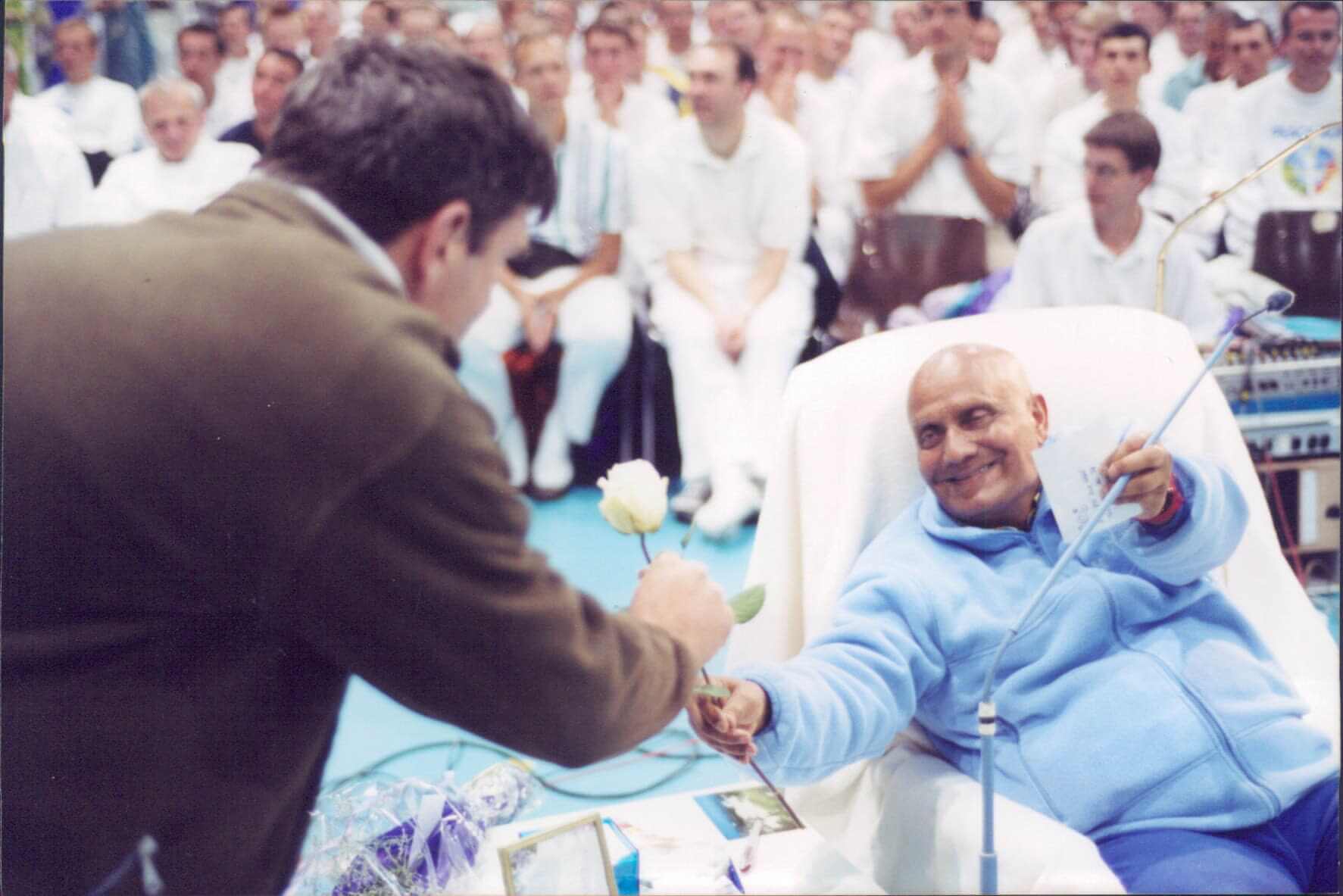
Sujantra receiving prasad from Sri Chinmoy
As the years go by, memory becomes a bit fuzzy. Guru wanted the San Diego Centre to have seventy disciples. Now, I’m not sure if he gave this number to the San Diego Centre exclusively, or if it was a goal to be met by all centres worldwide; but I definitely remember Guru asking on one of his last visits to San Diego, how many disciples we had. At that time, there were between thirty-five and forty disciples in the centre. Guru replied that this number was “below our dignity.” When he visited our new, larger Centre, he said the day would come when we would outgrow it.
In the late 1990s, the San Diego Sri Chinmoy Centre made a concerted effort to reach the goal of seventy disciples and, in the end, we made it—for one day! The key to our temporary success was a focused effort by many disciples to reach out to the broader San Diego community and offer ways for the public to connect with Sri Chinmoy. Until then, most of our outreach was focused on giving classes, but Guru said there were many other ways to bring new members to the Centre, ways that had not been tried.
A New York disciple once asked Guru what they could do to make the weekly Centre meeting more appealing to the existing disciples. Guru’s immediate response was, “Better Prasad!” Prasad is a traditional part of the Indian temple experience. The worshipers bring food or flowers and symbolically offer them to the deity. After the service, the worshipers take the Prasad for themselves. Sri Chinmoy brought this tradition of Prasad to America, so there is always Prasad after every meditation in the Sri Chinmoy Centres. Sometimes Prasad was brought by the disciples, sometimes by Guru, and sometimes by both Guru and the disciples. I can’t tell you how many times just the thought of Dunkin’ Donuts for Prasad motivated me to stay and meditate longer than I otherwise would have!
At our peak of seventy disciples, the centre had Jyoti-Bihanga as our prime asset. The restaurant had a nice upstairs classroom. We used it for musical concerts and meditation classes. Everyone in the Centre participated in these programs in one way or another. We had a ’70 Club.’ Disciples pledged $70 per month to fund newspaper ads promoting our events. Some of us gave classes, others postered, and some came to meet and greet seekers before and after the classes. Others made cookies and refreshments. It was our combined effort and energy as a group that drew people to the centre.
All seekers are attuned to what they are seeking. They intuitively know what they are looking for and they observe us and our events closely. They notice the subtle things, like how we disciples interact with each other as well as how we interact with guests. Seekers are always asking the question, “Will I be happy here?” Naturally, they look closely to see if those sponsoring an event are happy.
In my travels around the world, I couldn’t help but notice how small many of our centres were. Even though we said we had a centre in this or that city, the reality might be that centre had only four people and no permanent place to meet. On Christmas trips, Guru used to ask me to report on my travels. In one annual report, I listed all the centres in America and noted the size of each. Only hours after I sent my report to Guru, he called a meeting of the centre leaders and gave a very serious talk about the need to increase the size of the centres. A few years later, Guru decided that any group with fewer than twelve people would be called a ‘meditation group,’ rather than a centre and the leader would be referred to as a ‘meditation teacher,’ not a ‘centre leader.’