PILGRIMAGE BLOG
Sujantra’s Story Chapter 22: Humor Part 1
Welcome to the twenty-second blog in a series about my spiritual journey. You can pick up this tale at any point. Earlier blogs may reveal more details about the characters and scenes you encounter in this blog. Enjoy. –Sujantra
Chapter 22
Humor Part 1
Humor
Humor is my life’s fear and tear killer.
— Sri Chinmoy
As the New Millennium dawned, so did one of my long-hidden talents—humor. The seed of humor’s awakening in my life, and the beginning of what would be many Christmas Trip performances, was planted years earlier on one of Guru’s visits to San Francisco. Pujari and I staged a humorous rendition of Guru’s play, The Farmer and the Artist. We performed for Guru and about 150 disciples in a small auditorium of the local YMCA. As it turned out, everyone who saw that performance had a good laugh. After the play, Guru asked Pujari and me if we were going to New York for the upcoming April Celebrations. We said we were, and Guru asked us to perform the same play in New York.
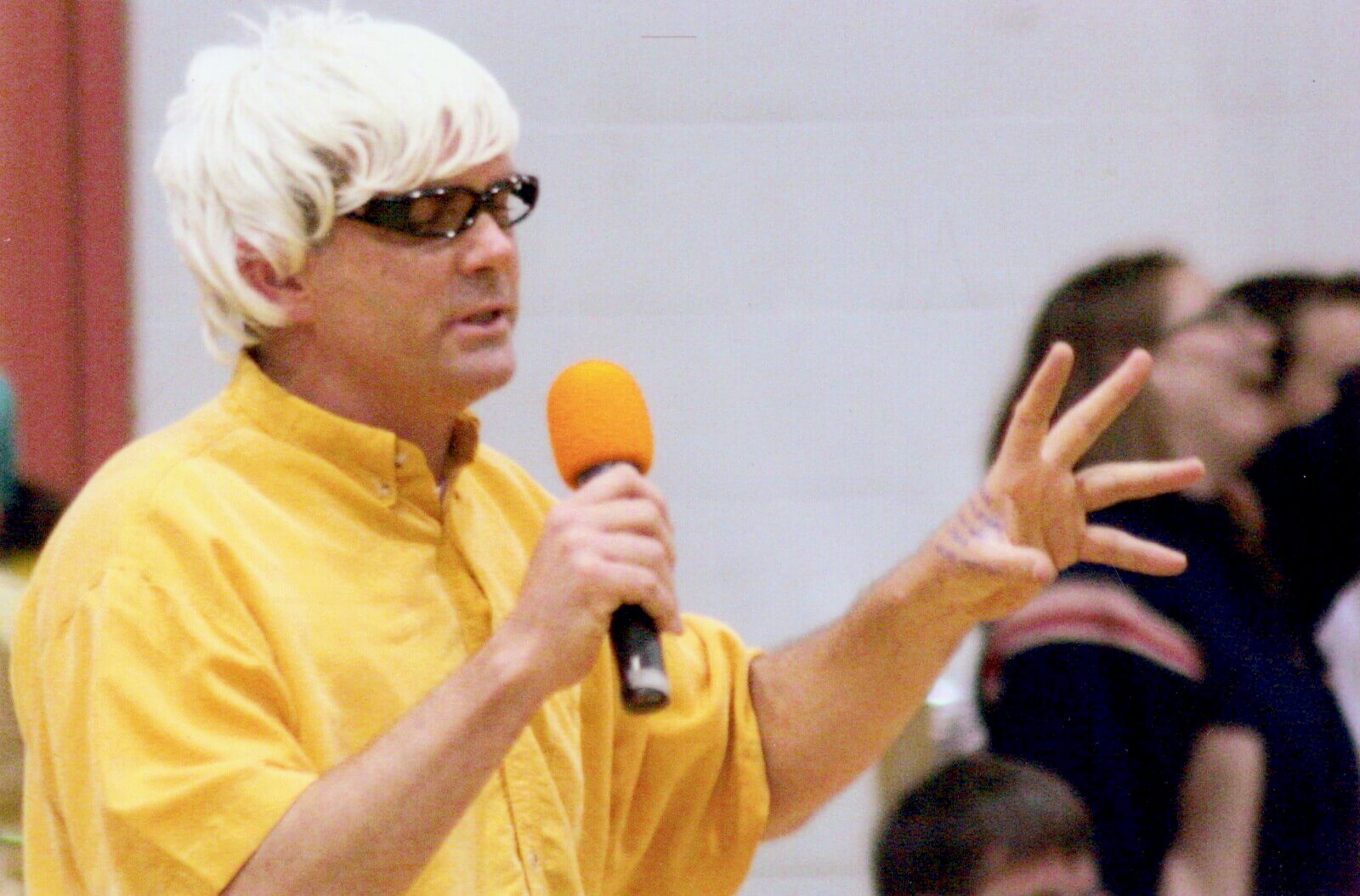
Sujantra’s comedy character Sukaji
Pujari became a disciple in the Santa Barbara Centre at age 24 and proved to be a great partner my productions. He came to the Centre as an experienced puppeteer, having studied art in college and spent several years as a Christian missionary in Paraguay working with kids. In those days, we had Centres in San Diego, Los Angeles, Santa Barbara, San Luis Obispo, San Jose, San Francisco, and Sacramento.
Guru began requesting the disciples to provide entertainment at the evening functions during the Christmas Trip. This was to help everyone unwind and relax. He insisted on a minimum of four plays a night, the merrier the better. I remember an evening when fourteen plays were performed! Guru loved to laugh. He enjoyed watching Jackie Gleason’s TV show, “The Honeymooners,” and John Cleese’s“Fawlty Towers.” Sometimes he would ask his disciples to act out various episodes of these shows. In addition to these skits, other entertainments were on display. Some disciples even performed magic!
The Christmas Trip plays were especially delightful because of the playful, creative spirit that emanated from Guru. We were all eager to receive and express that spirit. There was a time, however, when I was not very involved. I felt content to sit in the audience and take it all in appreciatively. I didn’t go onstage very often. Then, one day, while Guru was soliciting volunteers to perform in the evening plays, he turned to me. I was just sitting in the audience having a very nice meditation, until he said, “Sujantra, please be involved in the plays.”
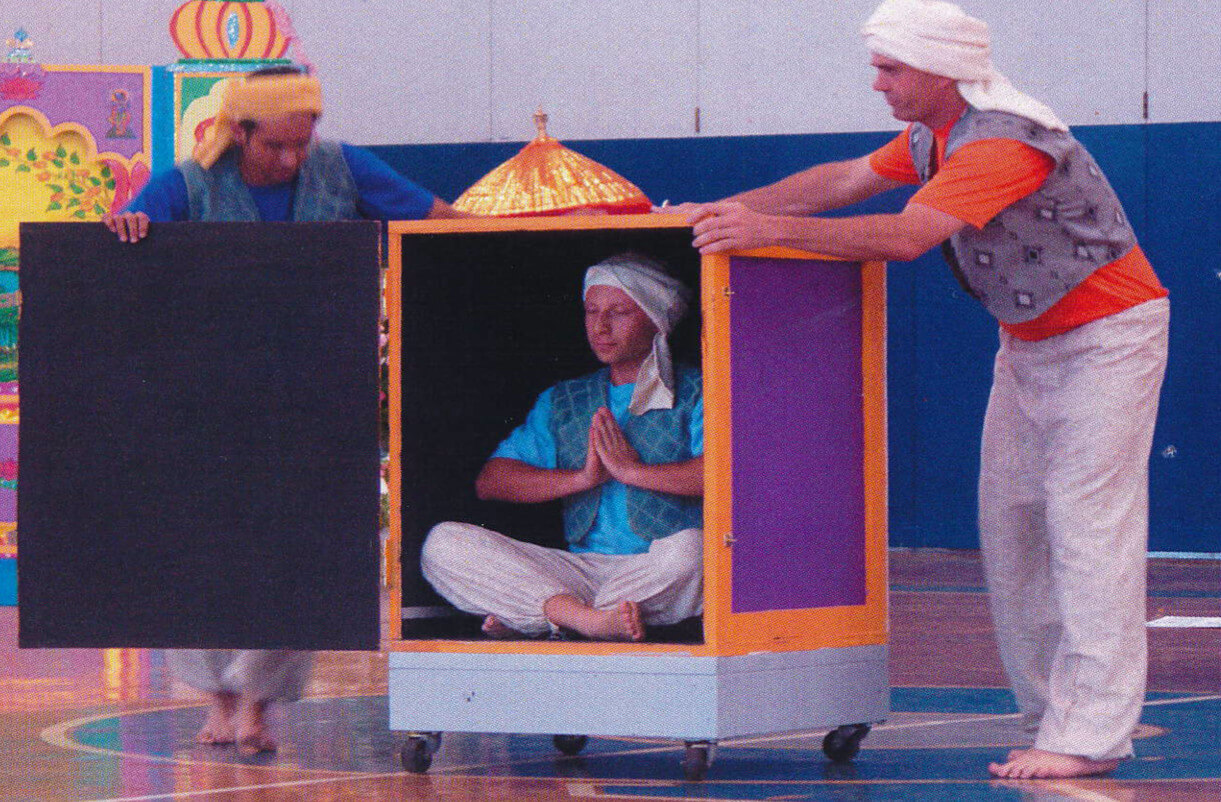
My magic act in NY
Whenever Guru asks you to do something, it’s both a blessing and a challenge. The challenge for me was to face up to and overcome my self-consciousness, my lethargy, and my insecurity. To do that, I had to step out of my comfort zone. The blessing part of Guru’s request was to be opened and awakened by the challenge to a new dimension of myself. It’s far too easy to become complacent in life and get stuck in one’s habitual ways. Guru was always keen to find ways to get us unstuck.
At Guru’s request, I began assembling a troop of boys, mostly my friends, for my plays. One thing I learned early on was how to use untrained actors: assign them characters as close as possible to their own. Everyone has talent, in one form or another, so the challenge of a director is to bring out each actor’s talent in each project.
As for my own character, I would describe myself as something of a perfectionist and as a very competitive person. When I do something, I try to do it well. If others are doing the same thing, I can enjoy friendly competition. With four or more plays every evening, there was plenty of competition! After many years of watching plays in the Centre, I would have to say my favorites were those that made people laugh. As a ‘big-time producer’ of entertainment on the Christmas Trip, I made it my foremost priority to create humorous plays.
There is really no better way to learn playwriting and hone the art of stagecraft than to perform in front of a live audience. The basis of our earlier plays was Guru’s stories. I must admit that in learning the art, our little troop of actors went through some trials and tribulations, including a few comic musicals that audiences sat through in pin-drop silence. Perhaps they weren’t as funny, or as musical, as we thought!
An audience needs to identify the underlying nature of each character within the first 20–30 seconds of their appearance on stage. That’s most important. People come to the theater to be moved emotionally. Whether from laughter or tears, they want to be moved. Audiences will give any production an opportunity to succeed, but if you fail to connect, they can be ruthless! If your audience becomes confused, it will shut down. As an actor, you’ll know when this happens. You’ll be looking out at a sea of cold, expressionless faces—not a pleasant experience for an actor!
Sukaji
Like any troupe of entertainers, we had some hits and misses, some trials and tribulations, but it was in an obscure city in far-off Indonesia that we had our first real triumph. That was with the production of Guru’s play, The Scholar’s Address. The play is a charming story about a scholar who has been invited to speak before a distinguished audience, but before he can speak, he must be introduced. Therein lies the problem that must be resolved.
For our play, we created six outlandish but charming characters. These were the characters who introduced the great scholar. Each is extremely long-winded. The poor scholar stands up each time he believes his introducer is about to finish, but then, the introduction just goes on and on. With each speaker, the scholar makes the mistake of standing up and walking toward the podium, only to have to slink down and crawl back to his seat as the introduction rambles on and on. The audience and Guru loved the play.
Nirav, a 30-year-old disciple from the Chicago Center, stole the show that night. He portrayed a professor from the University of Delhi who goes through a series of mishaps on the way to the scholar’s speech. His performance left the audience in stitches, and I realized immediately what a comedic genius Nirav was.
At the end of these absurdly long-winded introductions, the poor professor does finally make his way to the podium. Obviously exacerbated, he looks out at the audience and declares, “My address (long comedic pause)… is 35 San Lorenzo, San Francisco, California, 94127” – a perfect ending to a great night for our play troupe. Just five nights later, Sukaji was born.
The character of Sukaji was first introduced in our adaptation of The Pilgrims, a play by Sri Chinmoy. In the story, two brothers set out on a long journey on foot to a distant town. On their way, they encounter a group of spiritual seekers on a pilgrimage to the same town. To alleviate their boredom, the brothers decide to fall in line and travel with these pilgrims. As the brothers come to learn, the pilgrims have taken a vow of silence. The humor of the play arises when the two brothers try to get the pilgrims to break their vow of silence. The two good-natured but bumbling brothers seek to get the pilgrims to talk using every trick in the book. They try to strike up conversations about anything that comes to mind. They try cricket, food, spiritual philosophy—even coffee.
This play was a fantastic hit with both Guru and the audience. Looking back on the production, I can see how a number of elements came together to create Sukaji and Dukaji, two lovable clowns who were to be the focus of my theatrical creativity for the next five years. “Sukaji” and “Dukaji” are Bengali names that mean “happiness” and “sadness, or suffering.” Their personalities match the two classic masks of the theater – one a laughing smile, the other a tearful frown. In creating our characters, Nirav and I looked at the map of India and created two personalities whose identities were based on the names and locations of rivers, towns, and mountain ranges. This added a rich background and context to our characters.
If Guru had his way, he would have had Nirav and me perform for him every evening. Usually, Guru would give us about five days after one performance to stage another. That was the cycle or rhythm he set for us, from production to conception, and back into production again—five days. Sukaji and Dukaji were sympathetic characters popular with audiences because they resonated with the inner experience of every spiritual seeker. They were brothers and best friends, trying their best to make spiritual progress, but always coming up against their limitations in a world that neither understood them nor appreciated their naïve and overly literal understanding of spirituality.
One of the amazing things about Guru was his ability to turn his own inner intensity into a spiritual atmosphere that was engaging and tangible to every person present. If he gave a serious spiritual talk, there would be pin-drop silence. Similarly, when he felt it was time to laugh at life or at ourselves, we laughed. Nothing was sacrosanct. Nirav and I ended one of our comic plays on a serious note by reciting one of the most famous of verses from the Upanishads: “Lead me from the unreal to the real, lead me from darkness to light, lead me from death to immortality.”
At the end of that evening, as we were passing through the Prasad line, Guru stopped Nirav and I and said he thought the play was super excellent, but there was one thing wrong with it. Guru then paused for dramatic effect, and when he was sure all present were listening in, he said, “I thought you were going to say, ‘lead me from the real to the unreal, from light to darkness, from immortality to death!’” When it comes to laughing at ourselves, really, nothing is sacred. Guru wanted to make sure we understood that.

Sujantra golfing with Sri Chinmoy looking on
Nirav was an excellent singer, so it became a trademark of our productions to end with a song. We would take popular tunes and change their lyrics to match the play’s theme. We did gospel, folk, songs made popular by Frank Sinatra, Indian music, and more. We even threw in a little dancing! One night, after a performance, Guru called us up. His face bore a very stern expression. Speaking into the microphone so all of the 400 disciples present could hear, he said, “The performance tonight was excellent – only one problem…” Nirav and I had walked a pretty fine line in some of our performances, so we and all present were waiting with bated breath for the expected scolding. “Please,” Guru said, “more singing! More dancing!” With that, everyone laughed, realizing that pure, innocent joy knows no bounds.