PILGRIMAGE BLOG
Exploring Reality: Ontology, Realism, Idealism, and Yogic Wisdom
Exploring Reality: Ontology, Realism, Idealism, and Yogic Wisdom
by Sujantra McKeever, Pilgrimage Staff
What is “real”? It seems like a simple question until you actually try to answer it. Is the chair you’re sitting on a solid collection of atoms existing independently of you, or is it a mental representation—a collection of data processed by your brain?
The study of reality—what exists and how we perceive it—shapes both Western metaphysics and Eastern traditions. To explore this, we define the framework of existence (Ontology), consider two main perspectives (Realism and Idealism), and examine how Yogic wisdom bridges them.
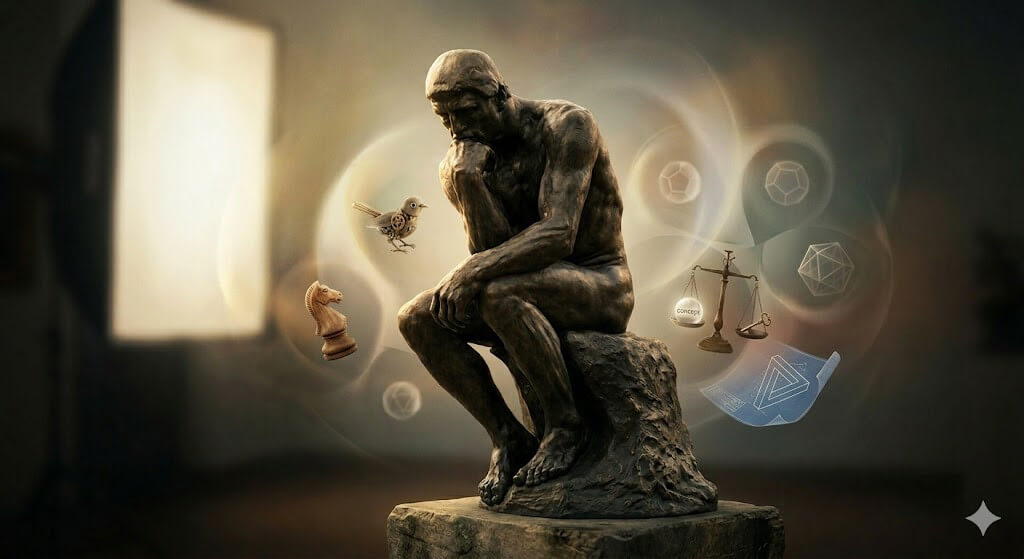
Do forms exist outside or within the mind?
1. Defining the Framework: Ontology
Ontology, in philosophy, refers to the branch of metaphysics that studies the nature of being and existence. While Epistemology asks, “How do we know what we know?”, Ontology asks the most fundamental question: What kinds of things actually exist?
An ontologist seeks to determine the “categories” of existence. They look at the universe and ask if it is composed of:
- Monism: One single substance (either all matter or all mind).
- Dualism: Two distinct substances (typically mind and matter).
- Pluralism: Many different types of substances.
With this ontological context established, we can now turn to two major philosophical perspectives. When we discuss Realism and Idealism, we are essentially debating the ontological status of the world around us. Does a mountain exist as a physical object made of atoms, or does it exist as a complex set of data within a mind?
2. Realism: The World of Independent Objects

Aristotle, John Locke, and Bertrand Russell – Foundational Realists
Realism holds that an external reality exists, regardless of our minds. In this view, the universe would persist even if no one were to observe it. Truth is independent, waiting to be discovered.
Popular Thinkers and Perspectives
- Aristotle: Often cited as the father of realism, Aristotle argued that “substances” are real and exist in the physical world. Unlike his teacher, Plato, who looked toward an abstract realm of “Forms,” Aristotle believed truth was found by observing the natural world.
- John Locke: A proponent of “Representative Realism,” Locke argued that while our senses might perceive things subjectively (like color or taste), the objects themselves have primary qualities (extension, motion, number) that are objectively real.
- Bertrand Russell: As a founding figure of analytic philosophy, Bertrand Russell famously revolted against idealism, championing a realist perspective that asserted the existence of a mind-independent reality.
3. Idealism: The World as Mind

George Berkeley, Immanuel Kant, and G.W.F. Hegel – Foundational Idealists
Idealism opposes Realism, claiming reality is fundamentally mental or immaterial. Here, the mind is primary, and the physical world depends on consciousness.
Popular Thinkers and Perspectives
- George Berkeley: Famous for the phrase Esse est percipi (“To be is to be perceived”). Berkeley argued that “matter” does not exist; only minds and the ideas within them exist. If a tree falls in a forest and no one is there to hear it, it only exists because God (the ultimate perceiver) is watching.
- Immanuel Kant: Kant introduced Transcendental Idealism. He argued that we can never know the “Thing-in-Itself” (the Noumenon). Instead, we only know the Phenomena—the world as filtered through the hardware of our human mind (like time and space).
- G.W.F. Hegel: Hegel proposed “Absolute Idealism,” suggesting that all of history and reality is the unfolding of a single, universal Spirit or Mind (Geist) seeking to understand itself.
Reflection 1: The Independent World: If all conscious life were to disappear tomorrow, do you believe the beauty of a sunset would still “exist,” or does beauty require a mind to perceive it? Does your answer lean more toward Realism or Idealism?
4. Connections to Yogic Philosophy
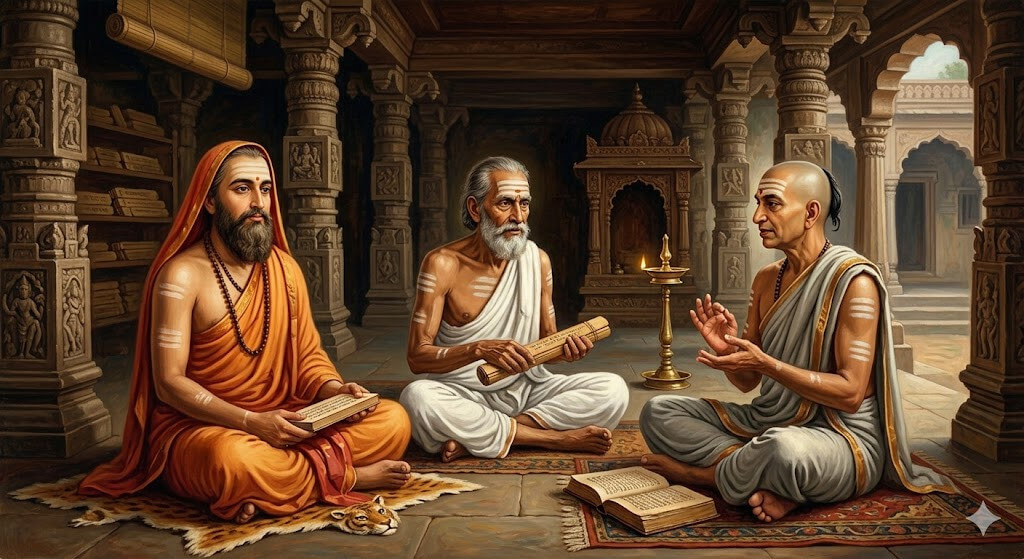
Shankaracharya, Patanjali, and Krishnamacharya – Foundational Yogic Thinkers
Yogic philosophy, particularly through the lenses of Samkhya and Advaita Vedanta, offers a sophisticated synthesis of these concepts that often predates Western terminology by millennia.
Samkhya: The Dualistic Realism
The Samkhya school, which provides the theoretical foundation for Yoga, is ontologically dualistic. It posits two eternal realities:
- Purusha: Pure, witness consciousness (resembling an Idealist’s primary substance).
- Prakriti: Primordial matter and the manifest universe (a Realist’s objective world).
In Samkhya, the physical world is “real,” but it is distinct from the self. Suffering arises because we confuse the two—we think we are our bodies or our thoughts. This is a form of Realism because it acknowledges that nature (Prakriti) is a real, functioning mechanism that exists even when we aren’t looking at it.
Advaita Vedanta: The Non-Dual Idealism
Advaita Vedanta, popularized by the sage Shankaracharya, moves closer to Absolute Idealism. It suggests that only Brahman (Universal Consciousness) is ultimately real. The manifest world is Maya—often translated as “illusion,” but more accurately described as a “relative reality.”
From the perspective of a human living in the world, the world is real (Realism). However, from the perspective of “Enlightenment,” the world is revealed to be a projection of the Divine Mind (Idealism).
The Yogic “Thing-in-Itself”
Where Kant argued that we can never know the Noumenon (the true reality), Yogic philosophy suggests that we can. This isn’t achieved through the thinking mind, but through the cessation of mental fluctuations as immortalized in Patanjali’s sutra 1.2:
Yogaś citta-vṛtti-nirodhaḥ
Yoga is the cessation of the fluctuations of the mind
By silencing the “filters” of the mind that Kant described—the ego, the memories, and the sensory biases—the yogi aims to perceive reality as it truly is. This is a state of direct, unmediated Realism achieved through an Idealist’s tool: the mastery of consciousness.
Yogic Practice in Action
Krishnamacharya revolutionized the ontological understanding of Yoga by shifting the focus from a purely static, ascetic liberation to a dynamic integration of the divine within the living human body. He asserted that the physical form is not merely a transient shell to be transcended, but a sacred instrument through which the practitioner can directly experience the underlying reality of the self. By synthesizing classical Sāṃkhya-Yoga dualism with a personalized, Viniyoga-based approach, he established a framework where individual existence is seen as a unique, evolving expression of universal consciousness.
Reflection 2: The Filter of the Mind: Think of a recent time you felt deep anger or sadness. Looking back, how much of that experience was based on “objective facts” (Realism) and how much was a construction of your own mental “filters” (Idealism/Maya)?
6. Conclusion: The Synthesis
The journey from Ontology to Yoga shows us that the debate between Realism and Idealism is not just an academic exercise. It is a question of how we relate to our lives.
- Realism reminds us of our responsibility to the physical world, the laws of nature, and the objective needs of others.
- Idealism reminds us of the power of our internal state, the subjective nature of our suffering, and the fact that we “color” the world with our own minds.
- Yogic Philosophy provides the bridge, suggesting that while the mind constructs our daily experience (Idealism), there is a deeper, objective Truth (Ontology) that can be realized through dedicated yogic practice and fulfillment of dharma.
Whether we view the world as a collection of atoms or a dream of the soul, these terms provide the vocabulary to ask the most important question of all: Who am I in relation to this? By understanding these frameworks, we don’t just learn about the world—we learn how to live within it with more clarity and purpose.
Reflection 3: The Witness Perspective: In your daily life, do you feel more like a participant lost in the material world (Prakriti) or a “witness” observing your thoughts and actions (Purusha)? How might shifting your perspective to the “witness” change how you handle stress?