PILGRIMAGE BLOG
The Untethered Soul: Integrating Michael Singer, Samkhya, and the Great Masters
The Untethered Soul and Samkhya Philosophy: Integrating Michael Singer and the Great Masters
by Sujantra McKeever, Pilgrimage Staff

“There is nothing more important to true growth than realizing that you are not the voice of the mind—you are the one who hears it.” — Michael Singer, The Untethered Soul
The journey of modern yoga often begins on a physical mat, but for the seasoned practitioner, it inevitably migrates to the landscape of the mind. We move from the alignment of the limbs to the alignment of consciousness itself. At the heart of this transition lies a profound question popularized by Michael Singer’s The Untethered Soul: Who is the one who watches? While Singer’s work has reached millions in the West, its roots are deeply embedded in the ancient soil of Samkhya Philosophy and the towering realizations of Ramana Maharshi and Sri Aurobindo. By weaving these perspectives together, we can map the path toward the Living Truth.
The Architecture of the Witness: Samkhya and Michael Singer
To understand the “Untethered Soul,” one must first understand the “Tethered” one. Samkhya philosophy, one of the oldest schools of Indian thought, provides the dualistic blueprint for this exploration. It divides existence into two eternal realities: Purusha (Pure Consciousness/the Witness) and Prakriti (Nature/Matter/Mind). This foundational framework suggests that our suffering arises from avidya, or the fundamental confusion of these two distinct realms. We mistakenly believe we are the changing movements of our personality, failing to recognize the silent, unchanging awareness that remains untouched by the theater of life. By studying the classical principles of Samkhya, we begin to see that our true nature is not the story, but the one who reads it.
In The Untethered Soul, Michael Singer modernizes this ancient dualism for the contemporary mind. He describes the “roommate” in your head—the incessant internal monologue that reacts, judges, and fears. This roommate is a manifestation of Prakriti—the shifting energy of the psyche. Singer’s “Seat of the Self” is a direct pointer to Purusha. When we practice yoga, we are essentially training ourselves to step back from the turbulent waters of nature and reside in the unshakable stillness of the Saksi (Witness awareness). By simply noticing the voice instead of being the voice, we break the tether of identification.
Reflection Question: How does the Samkhya distinction between Purusha (Witness) and Prakriti (Nature) help you navigate “bad moods” or emotional triggers?
The Inward Inquiry of Ramana Maharshi
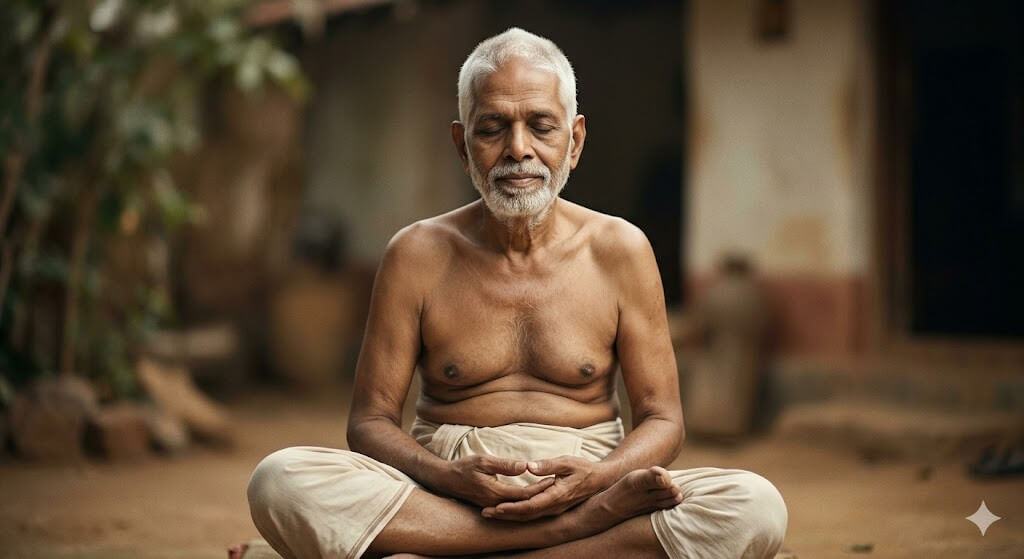
“Your duty is to be; not to be this or that. ‘I am that I am’ sums up the whole truth.” — Ramana Maharshi, The Teachings of Ramana Maharshi in His Own Words
While Samkhya provides the theoretical map, Ramana Maharshi provides the most direct practical compass. His method of Atma-Vichara (Self-Inquiry) begins and ends with the fundamental question: “Who am I?” This is not an intellectual exercise to find a verbal answer, but a search to find the source of the observer. Maharshi’s perspective strips away the layers of false identification—the labels, roles, and memories we cling to. He famously described the ego as a “ghost” that has no form of its own but thrives by feeding on the forms of the body and mind; once scrutinized through The Teachings of Bhagavan Sri Ramana Maharshi, this ghost is found to be non-existent.
If you can observe your thoughts, you are not your thoughts. This is the process of Viveka (discrimination). By relentlessly tracing the “I-thought” back to its source, the practitioner finds that the untethered soul isn’t something to be achieved through effort, but something to be uncovered through the dissolution of the “knot” between matter and awareness. This realization reveals that the Self is always present, like the sun behind the clouds. We do not need to create peace; we simply need to stop identifying with the mental noise that obscures it.
Reflection Activity: Set a timer for 5 minutes, find a meditative position, and repeat the following mantra out loud or silently: “Who am I?” After the time has elapsed, take a little time to reflect on how you feel or what comes up.
Sri Aurobindo and the Evolution of Consciousness

“The liberation from an externalized ego sense is the first step toward the soul’s freedom and mastery.” — Sri Aurobindo, The Synthesis of Yoga (1955 Edition)
If Ramana Maharshi represents the ascent into the silent Self, Sri Aurobindo offers the vision of the descent of that silence into life. In his seminal work, The Synthesis of Yoga, Aurobindo explains that the ego is merely an “instrumentation of Nature”—a temporary construct used by the soul to navigate physical existence until it is ready for a wider realization. He argues that the human experience is an evolutionary transition, moving from an unconscious identification with the body toward a divine consciousness that can inhabit the world without being lost to it. His philosophy of Integral Yoga posits that the spiritual life is not an escape, but a transformation.
Aurobindo’s Integral Yoga suggests that the goal is not merely to escape the world (Prakriti) to find the Witness (Purusha), but to transform nature itself into a vessel for the spirit. For Aurobindo, becoming the Witness is the “first step toward the soul’s freedom and mastery,” allowing us to participate in the world with dynamic power. We are no longer victims of our impulses but conscious co-creators, acting from a place of vastness rather than being imprisoned by the “habitual round” of the ego’s narrow desires and limitations.
Reflection Question: Sri Aurobindo speaks of a “self-imprisonment” in habitual action. What is one habit you have that maintains your sense of a “limited and separate” self?
Practical Application: From Theory to Transformation
For those following the Pilgrimage of the Heart blog, the integration of these philosophies is more than academic; it is a daily practice. It involves a “conscious relaxing” through the blockages Singer calls Samskaras—the stored past energies that cloud our perception. By exploring the relationship between Michael Singer’s teachings and those of the great Indian Masters, we gain confidence that the quest for this level of awareness is possible and that it is an experience that transcends culture, religion, and time.
- Awareness (The Samkhya Step): Recognize the distinction between your awareness and the object of awareness.
- Inquiry (The Maharshi Step): When a trigger arises, ask, “Who is experiencing this?”
- Surrender (The Singer Step): Lean into the discomfort and let the energy pass through you.
- Integration (The Aurobindo Step): Offer that clarity back into your life as a “master of your own inalienable power.”
Conclusion: The Unified Path to Freedom
The journey from the “tethered” ego to the “untethered” soul is the ultimate evolutionary shift. By grounding Michael Singer’s contemporary psychological insights in the architectural rigor of Samkhya and the enlightened perspectives of Ramana Maharshi and Sri Aurobindo, we see that the “Witness” is not a remote philosophical concept, but a living reality accessible to every practitioner. Whether through self-inquiry, the discrimination of Purusha from Prakriti, or the integral mastery of the mind, the goal remains the same: to untie the knot of identification and stand free as the conscious observer.