PILGRIMAGE BLOG
Yin v.s. Restorative Yoga
By Lauren McLaren
Were you to stand outside a yoga studio and peer in the window to see a bunch of yogis stationary on their mats in a reclined position, you might think that you were witnessing a Restorative Yoga 1 class, or you might think you were observing a Yin Yoga 2 class. Would you be able to tell the difference and know which class was in session? Most people won’t be able to tell the difference bet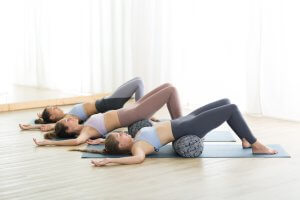 weenYin and Restorative Yoga without a deeper understanding of these two styles of practice.
On the surface, they seem very similar, and they do share a few characteristics, but there are substantial differences between Restorative Yoga and Yin Yoga practice, not the least of which is the intention behind the different styles. Because there are some common elements, these two practices are frequently confused. This article will help you know what you are getting into when you take a Yin or Restorative Yoga class.
Let’s talk about similarities first. Both Yin and Restorative Yoga are what we call passive practices. This means both involve a lot of stillness, and most postures will be floor-based. In Yin and Restorative Yoga, we refrain from using muscles to hold ourselves in a pose, so the body remains passive with as little muscular engagement as possible.
We also see a similarity in the hold time for their respective poses. In other styles of yoga, you might be asked to hold a pose for up to 10 breaths, but in Yin or Restorative Yoga, those holds will extend to several minutes instead of several breaths. The long holds allow the student to surrender to stillness and restore the body and mind, preparing them for deeper states of meditation and mindfulness.
With these important common traits evident, what are some of the differences between Yin Yoga and Restorative Yoga? These two styles diverge in several ways, from the names of the poses to the felt sense of the practice. The underlying philosophy of each yoga holds the key to understanding how different these styles really are.
The philosophy behind Restorative Yoga is rest—physical rest, emotional rest, mental rest. The experience is intended to be one in which there is no sensation of physical effort so that the student can release tension and long-held stress from the body and mind. One of the most essential tenets of Restorative Yoga is that we are not fixing anything. We are not pieces of broken equipment that need repair; instead, we are looking for a way to remove the obstacles between us and our well-being. There is no action to take and no physical end goal to meet in the Restorative Yoga mode of practice.
While release is common to both styles of practice, Yin Yoga will invite the student to focus their attention on the release of tension and immobility in the fascia and joints of the body. Yin Yoga addresses the dense connective tissue of the body, putting it in positions of controlled stress to create an intense physical sensation. By putting controlled stress on these tissues, either through compression or stretching for long periods, we encourage a lengthening and mobilization of fascia and tendons as well as a strengthening of the ligament tissue of the joints. So, this is a practice of creating a strong physical sensation in the body as opposed to Restorative Yoga, which allows the student to experience only a sensation of softening.
In a Restorative Yoga practice, students will make use of props, a lot of props, to create a position in which they can feel completely supported and able to relax. We employ many tools and techniques to create an environment where students can find a completely effortless experience of comfort. In any given posture, students may use blankets, blocks, and bolsters to build a supportive nest for themselves. Sandbags provide the students with a deeper sense of grounding. Belts hold the body in positions requiring more muscular effort. The props will be arranged with attention to skeletal alignment, so no effort is required beyond holding the mind in place.
Yin Yoga, on the other hand, is mostly practiced without any props. To access the connective tissues that are the target of Yin Yoga, we look to find poses that are assisted only by the force of gravity and the shape of the pose. We also look to keep the muscles soft and relaxed as this is how to direct controlled stress to the body’s fascia, tendons, ligaments, and joint capsules. In Yin Yoga, these dense tissues will slowly lengthen and become more fluid without muscular engagement. Props will hinder the process of strengthening and elongating by taking the edge off the sensations created by the body’s position.
We will encounter a few other differences between these two styles of yoga, most notably in the pose names and the hold times for the postures. Yin Yoga was created by several yogis from a Taoist and martial arts background. As such, the pose names are centered around animal forms. We will see the same poses called by different names depending on whether you are in a restorative or a yin class. The posture we call Bound Angle in Restorative Yoga is called Butterfly in Yin Yoga. They are essentially the same position, but how we practice them is very different.
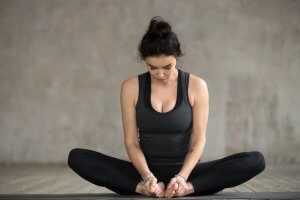
Though we do prolonged holds in both styles, the holds will be much longer in a Restorative Yoga class. You might be asked to stay in Butterfly in a Yin Yoga class for 5 or 6 minutes, but we would hold Bound Angle in a Restorative class for up to 20 minutes. The relatively shorter hold in a Yin Yoga class will promote the sensation of strength throughout the body, while the longer holds of a Restorative Yoga posture will give practitioners time to surrender both physically and mentally to stillness.
When you are choosing which style to practice, consider your current condition. Have you been feeling a lot of stress? Do you need to relax and give both mind and body a rest? If so, then take a Restorative Yoga class. Have you been working in the garden, gone on a challenging hike, or been sitting at your desk too long? If so, try a Yin Yoga class to loosen up some of the tightness in your body and break free from the effects of a sedentary lifestyle.
Both of these slower practices are wonderful in their own ways, and both address the reality of an unbalanced society. In the language of Yin Yoga, our world leans toward Yang energy. With Yin and Restorative Yoga practices, we create a more balanced and harmonious state of well-being that contributes to our overall health.