PILGRIMAGE BLOG
What is the Third Noble Truth?
What is the Third Noble Truth?
A Conversation on The Four Noble Truths of the Buddha
Part 3 – There is an End to Suffering
By Sujantra and Astika
The following conversation between Sujantra McKeever and Astika Mason occurred on March 13, 2025. The first part of the discussion, on the first Noble Truth, is here.
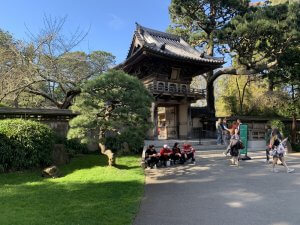
Photo by Sujantra from San Francisco Japanese Friendship Garden
Sujantra: So, Nirodha is the end of desire. How does that come about?
Astika: Slowly, very slowly. No one can put an end to desire by will power alone. Think of working in your garden. There are weeds and there are flowers. You pull the weeds up and for a brief time, there are only flowers—lovely! But then the weeds come back. Why? Because you didn’t pull out the root of the weeds.
Sujantra: Suffering then has two parts: the symptoms that we see and feel, and the causes that are unseen and perhaps even unfelt. The ‘root’ that is below ground, so to speak.
Astika: According to the Buddha, desire or tanha is the root cause of suffering, so you have to be aware of how every desire affects you. Any desire can make us unhappy, if for no other reason than its impermanence. The satisfactions that come from fulfilling desire don’t last long. Clinging to a desire and allowing it to redirect your life energies is a much bigger problem. That’s like pouring gasoline on a fire. Samudaya is a condition of change that results from clinging to a desire and allowing it to alter your consciousness, and sometimes your outer life.
Sujantra: Samudaya?
Astika: Literally, entering, or growing into a new reality, a new identity. Most desires are pleasant, but we don’t “crave” them so intensely that they alter our sense of self. However, even a seemingly insignificant desire, if repeatedly indulged, can inject itself into our personality and begin to alter it. An intense desire can cause us to alter our behavior.
Sujantra: Like a drug addict who begins stealing to support his habit.
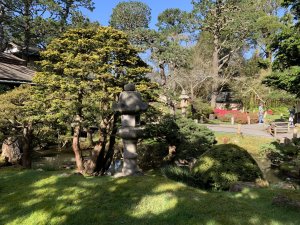
Photo by Sujantra from San Francisco Japanese Friendship Garden
Astika: Yes, but a physical object or substance does not have to be involved. An ambition can have the same effect. I had an ambition to be a soldier, probably based on an attraction to uniforms and march music when I was a kid. This is very common among young boys who want to feel empowered and important. Superficial attractions can seduce us and prevent us from learning who we actually are in a deeper way. We begin to walk a path that is unsuited to our inmost nature.
I’m picking on men, but let’s look at women. The desire to be popular and beautiful can easily become obsessive and then oppressive. In modern society, we’re trying to break away from the past habit of seeing females as ‘objects of desire’ for males, but we’ve made very slow progress in this respect because it’s ingrained in the human psyche. And some people are struggling to embrace present social norms. This is true for immigrants from different cultures, but it’s also true for many people born and raised in this culture. An individual who wants to evolve past the social norm to an even higher ethical standard will have to be very dedicated to the effort because it is easy to slide back into old habits in the company of those who accept and like those habits.
This is one of many reasons why a spiritual practice is helpful. Meditation allows us to see more deeply into the root causes of our unhappiness. It also gives insight into how to be the master of your own life and overcome addictive causation—tanha (excessive desire) and samudaya (deluded becoming).
Sujantra: Why do we cling to habits that we know are not good for us?
Astika: The reasons are many. I couldn’t name them all, but I doubt there’s a single person who doesn’t cling to at least one harmful habit. We have this psychic weakness that comes from not deeply knowing who we are. In our depths, no one is a slave to any desire, but to realize and feel this, you have to live from that depth. The body’s many thirsts and the mind’s various ambitions possess a superficial power to motivate us, but most are useless to the deep self, which wants peace, light, and a deeper satisfaction. If we can live from that deeper perspective, we have the power to be truly free from all attractions and to guide our own destiny.
Sujantra: Today, we know so much about the body and mind, what’s healthy and what isn’t. It seems like we should be making more progress. People should be happier.
Astika: We’re learning, but information isn’t enough. We also need deeper wisdom to make use of the information. From wisdom there arises clarity and a joyful will that will put information to good use. I think we are so distracted by surface attractions that we’re losing our ability to focus inwardly in a deep way. We have so many possibilities tugging at us, we can’t give our full attention to any of them. This leads to a condition of psychic weakness, where the inner and outer life are not in sync. It’s like a muscle you don’t use. You know it’s there, and what it’s for, but if you don’t regularly use it, atrophy sets in. You lose the ability. People know they should do this or that to improve their lives, but they don’t because they lack the inspiration and will to break away from the habits that chain them to negative outcomes.
Sujantra: It’s like T.S. Eliot wrote in The Hollow Men, we go out not with a bang but a whimper.
Astika: Aptly put, except that our desires don’t go out. We remain entangled in frustrations. We don’t come close to extinguishing our desires (Nirodha), and we don’t manage the ones we keep very well. They manage us.
Sujantra: Returning to this idea of Nirodha …. The complete extinction of desire doesn’t seem healthy. A certain level of desire and ambition makes life worthwhile; it gives us something to live for, doesn’t it?
Astika: Yes. My teacher, Sri Chinmoy, used to say we should always have a project, a goal. That would be a desire and an ambition, but to create good in the world, not satisfy personal desires and ambitions. In yoga, we speak of the tamasic, the rajasic, and the sattvic. Desire motivates the tamasic, unmotivated person to get moving and do something meaningful. It keeps the rajasic and very desirous person striving for greater achievements. But, eventually, the rajasic person discovers that his or her achievements no longer satisfy. Then, the inner work begins, and the sattvic, or truly noble person, comes into being. We evolve from one stage of development to the next by letting go of what no longer satisfies or serves its purpose. We don’t cling to past habits. We keep creating new and better habits until we transcend ‘habit’ altogether and act from a purer and higher will.
A Buddhist parable addresses this paradox of desire. You use a raft to get across a river, but once there, you don’t carry the raft around on your back. You leave it at the shore and go on your own two feet. The raft is like a motivating but selfish desire. It was useful once, but no longer. Now, we seek a higher and more selfless satisfaction. This doesn’t happen from guilt or by shaming yourself to be more selfless. It happens only when selfless actions become more fulfilling to you than self-serving actions. To travel well through life, you have to know yourself deeply. You have to know who is traveling and why at each stage of the journey. This is liberating yourself from the suffering of tanha and samudaya.

Photo by Sujantra from Japanese Friendship Garden in San Francisco
One step at a time. We begin by self-examination and being honest about who and where we are in the journey. Most of us are learning ‘desire management.’ In this respect, we are like the Buddha’s lay followers, who had families and were engaged in worldly affairs, but the Buddha also taught those who had renounced home life and wanted complete and perfect enlightenment. They would need to attain nirodha and extinguish all desire and any sense of personal self.
Sujantra: That feels like two very different paths.
Astika: The same path but very different stages of the journey. There is a great deal of confusion amongst sincere seekers about what instruction they should follow. Many grasp at the loftiest goals and seek what’s above their ability. They then become frustrated and down on themselves, or they reject the practice as impractical or wrong. This is because they don’t get the result they thought they would. This is because they had not yet acquired the deep necessity for those objectives. Others are hindered by common clichés and shallow methods that don’t yield the deeper awareness or experience they need and are ready for.
Sujantra: That’s a tragic dilemma. How does one know what to do?
Astika: As far as I know, there are only two approaches to this problem. One is to find a spiritual teacher you can trust and entrust yourself to that person, let them guide you. The other is to learn to trust yourself. This can only be done through deep prayer and meditation. Go deep within and get to know your deepest inmost self. Then, live from their rather than chase after all the surface desires of the body and brain.
Sujantra: All right. So, how do I proceed in my life of aspiration?
Astika: Always, it depends on who and where you are in your self-identity. How much desire-baggage do you need to carry? What can you let go of? Start with modest spiritual objectives, goals you sincerely believe you can attain, rather than grandiose ideals you can’t reach. If you don’t have a satisfactory meditation practice, this is the time to get one. That’s Square One. Just sit silently within yourself. Learn to be comfortable within your own inner silence. That will bring you face-to-face with a deeper and truer identity. Get comfortable with your silent self.
This doesn’t mean stop talking or take a vow of silence. The silence you visit in your meditation will come forward and express itself in your everyday speech, in your thoughts and actions, and in your emotions as well. You will become calmer, better focused, and more mindful. This will happen automatically if you meditate regularly. Automatic, yes, but it will be gradual and more slowly than you might like. If you also practice mindfulness in your day-to-day life, it will happen faster. Much of the suffering that afflicts your life will gradually fade and begin to disappear as you practice meditation and mindfulness.
Sujantra: Is there a mindfulness practice you recommend?
Astika: No, I think most will work if you sincerely practice them. The Buddha recommended one that came to him in his Enlightenment moment. I doubt you can go wrong with that.
Sujantra: What was The Buddha’s recommendation?
Astika: He called it “The Eightfold Path.” That was his Fourth Noble Truth.